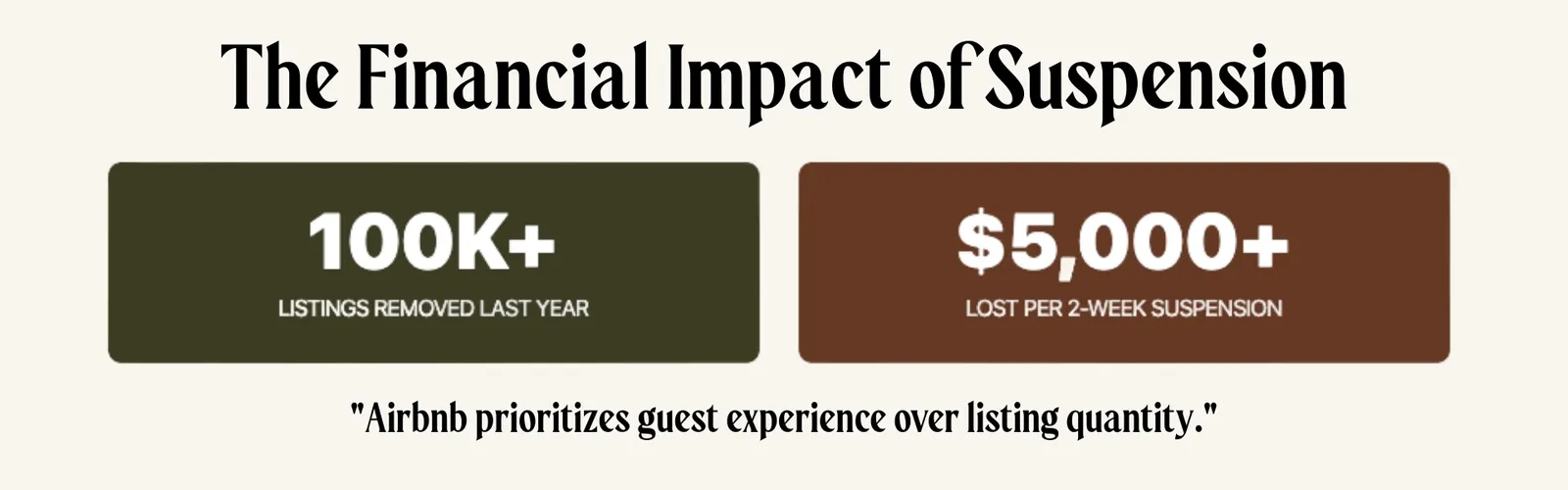
Airbnb listing suspensions are becoming more common. Over 100,000 listings were removed from the platform in the last year alone. If your ratings drop below Airbnb’s quality standards, your listing gets flagged. Continued underperformance leads to temporary suspension, and eventually, permanent removal from the platform.
A two-week suspension can cost upwards of $5,000 in lost bookings. For operators managing multiple properties, the financial impact multiplies quickly.
In this guide, you’ll learn the prevention systems that operators use to maintain ratings above 4.9 across large portfolios. We’ll cover cleaner reporting protocols, guest communication strategies, review removal processes, and why channel diversification matters more now than ever before.
These are the systems operators with 100+ listings use daily to catch problems before guests experience them.
Why Airbnb Is Removing Listings
Airbnb’s strategy shifted from growing inventory to protecting quality. The company invited select operators to their headquarters summit in late 2025, where leadership made their priorities clear: they want to eliminate bad guest experiences.
New users who have negative experiences rarely return to the platform. Airbnb recognizes that protecting their reputation requires removing underperforming listings, even if it means shrinking their total inventory count.
Market data from PriceLabs and other sources shows declining Airbnb inventory in many cities. While some operators are leaving the market, a significant portion of these removals are Airbnb actively delisting properties that don’t meet their quality standards.
The message is clear: Airbnb prioritizes guest experience over listing quantity. Operators who can’t maintain high ratings will lose access to the platform.
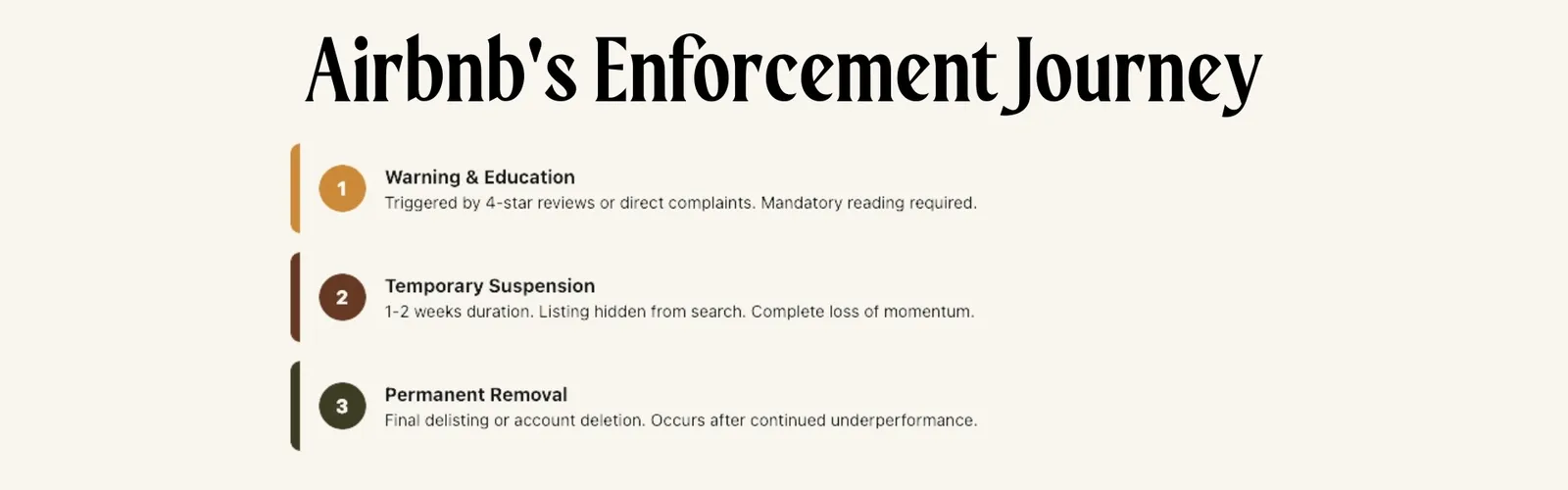
How the Three-Stage Suspension Process Works
Understanding Airbnb’s enforcement process helps operators recognize warning signs early and take corrective action before suspensions happen.
Stage 1: Warning and Educational Content
When you receive a few four-star reviews or direct guest complaints to Airbnb, the platform flags your listing. Airbnb requires you to read articles about improving guest experience and addressing common hosting issues.
This stage serves as an early warning system. The platform is telling you that your performance is slipping and needs immediate attention.
Stage 2: Temporary Suspension
If ratings don’t improve or guest complaints continue, Airbnb temporarily suspends your listing. The suspension typically lasts one to two weeks, depending on the severity of issues.
During suspension, your listing disappears from search results. You lose bookings, revenue, and calendar momentum. We’ve seen operators lose $5,000 or more during short suspensions.
Stage 3: Permanent Removal
Continued poor performance leads to permanent removal from the platform. In some cases, Airbnb may even delete your entire account, removing all listings simultaneously.
Account deletion happens rarely, but we’ve seen it occur in our community. Sometimes the reasons are clear (multiple bad ratings, serious guest complaints). Other times, Airbnb doesn’t provide detailed explanations because they’re not required to justify account closures.
The Myth of Maintaining High Ratings at Scale
Many operators believe maintaining high ratings becomes impossible as portfolios grow. The assumption is that more properties mean more problems, and more problems inevitably lead to lower ratings.
The data shows the opposite.
Operators managing 100+ listings consistently maintain ratings above 4.9. Several maintain averages above 4.8 year-round across large, diverse portfolios.
These operators deal with the same challenges everyone faces: difficult guests, equipment failures, weather events, team mistakes. The difference isn’t luck or perfect properties. The difference is systems.
They’ve built prevention systems that catch issues before guests experience them. They’ve trained teams to communicate proactively, and created recovery protocols for when things inevitably go wrong.
High ratings at scale come from treating guest experience as a systematic process, not an occasional priority.
Prevention System 1: Cleaner Reporting Protocols
The most common reason operators get bad reviews is discovering problems after guests have already experienced them. A broken dryer, a malfunctioning appliance, or missing amenities become guest complaints instead of maintenance tasks.
Train cleaners to report issues during turnovers, not after guests check in. Create simple reporting systems where cleaners can flag problems immediately using their phones or tablets.
If you have quality inspectors, use them to double-check that everything functions properly before the next guest arrives. The goal is catching broken amenities before guests discover them.
This seems obvious, but many operations lack systematic reporting. Cleaners finish their work and leave without checking that appliances work, lights function, or heating and cooling systems operate correctly.
Build a checklist. Make reporting mandatory. Review reports daily. Fix issues immediately.
Prevention System 2: Proactive Guest Communication
Set clear expectations before guests arrive. Explain what they should expect during their stay. Transparency prevents disappointment.
Many negative reviews stem from mismatched expectations. Guests imagine one experience based on photos and descriptions, then arrive to find something different. The property might be perfectly fine, but the gap between expectation and reality creates dissatisfaction.
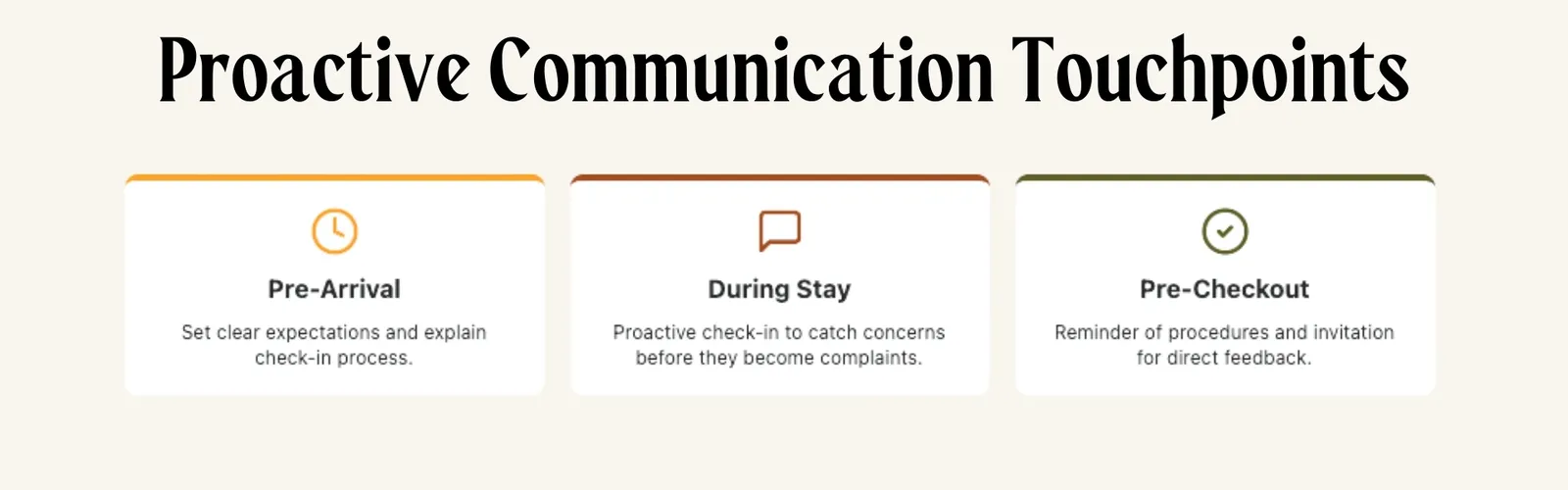
Communication should happen at multiple touchpoints:
- Pre-arrival: Confirm booking details, explain check-in process, set expectations about property features and neighborhood characteristics.
- During stay: Check in proactively to ensure everything meets expectations. Address concerns before they become complaints.
- Pre-checkout: Remind guests about checkout procedures and invite them to share feedback directly with you first.
Proactive communication builds trust. Guests who feel informed and cared for are more forgiving when minor issues occur.
Prevention System 3: Go Beyond Clean and Functional
Clean and functional is the baseline, not the goal. Operators maintaining the highest ratings look for opportunities to exceed expectations in small, memorable ways.
This doesn’t mean luxury amenities or expensive upgrades. Small touches create memorable experiences:
- Local coffee or tea in the kitchen
- Personalized welcome notes
- Recommendations for nearby restaurants and activities
- Flexible checkout times when possible
- Thoughtful touches that show you care about their specific needs
The book Unreasonable Hospitality by Will Guidara explores this concept in depth. While the book focuses on restaurants, the hospitality principles translate directly to short-term rentals.
Every Freewyld team member reads this book because it reframes how we think about guest experience. The goal isn’t perfection. The goal is making guests feel genuinely cared for.
How to Respond When Things Go Wrong
Equipment fails. Weather disrupts plans. Team members make mistakes. Problems are inevitable in any hospitality business.
Guests understand this reality. What they care about is how you respond when problems occur.
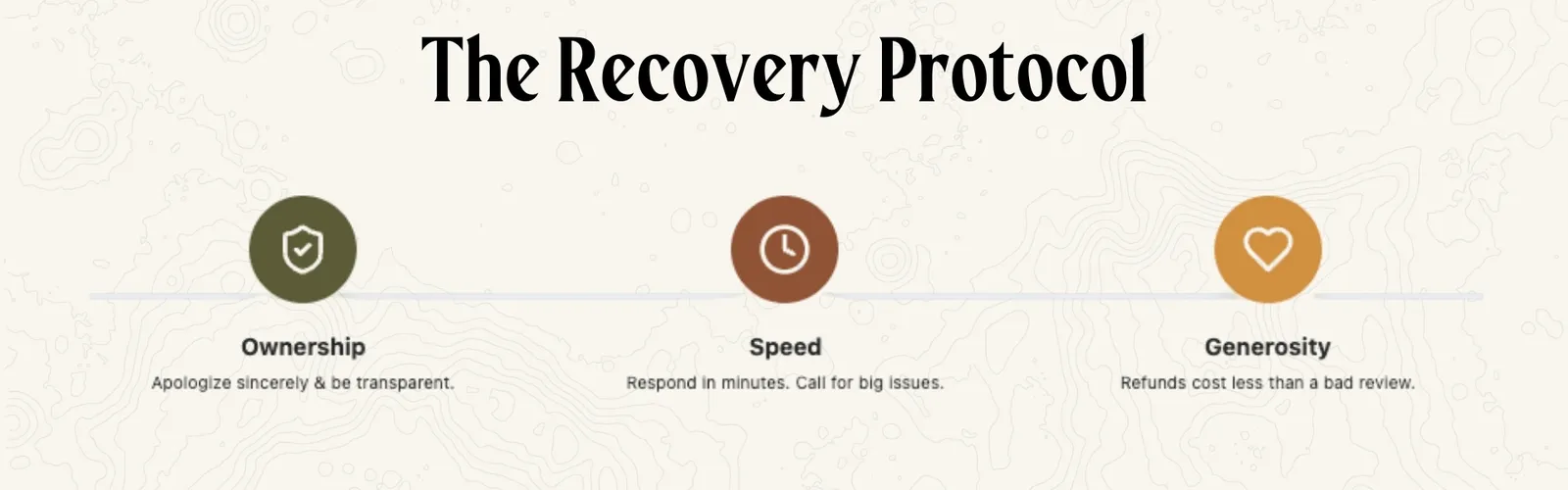
Ownership and Transparency
Take ownership immediately. Don’t blame circumstances, other people, or factors outside your control. Acknowledge the issue, apologize sincerely, and explain what you’re doing to fix it.
Transparency matters. Guests want to know their experience matters to you. They want to feel genuinely looked after, not like a transaction to be managed.
Speed of Response
Respond quickly. A problem that gets addressed within minutes or hours feels manageable. A problem that lingers for days becomes a crisis.
Call guests when significant issues occur. Don’t just send messages. Voice communication creates connection and demonstrates urgency. Guests can hear your concern and commitment to resolving the situation.
Making It Right
Offer refunds or compensation when appropriate. Yes, some guests will take advantage and request unreasonable refunds. But paying a larger refund than you think is fair often costs less than the damage from a bad review.
Calculate the economics: a one or two-star review can depress bookings for months. The listing might lose thousands in revenue while you work to improve ratings. A $500 refund to prevent that review is often the better business decision.
Error on the side of generosity when handling guest complaints. Protect your ratings first, debate fairness later.
Educating Guests About Airbnb’s Rating System
Many guests don’t understand how Airbnb’s rating system works. They’re accustomed to hotel ratings where three or four stars represents a positive experience.
On Airbnb, three or four stars signals a problem. New users especially struggle with this distinction.
We’ve seen reviews where guests leave glowing written feedback but assign three or four stars. When contacted, they explain they thought three stars meant “good, like a three-star hotel.” They had no idea this would flag the listing or trigger potential suspension.
How to Educate Guests
Magnets and signage: Place fridge magnets or small signs explaining Airbnb’s rating system. Some use humor (“Five stars means you didn’t burn the place down”). Others are direct and educational.
Pre-checkout communication: Send a message before guests leave explaining how ratings work and why five stars represents “met expectations” rather than “luxury perfection.”
Market-specific approach: Guest education matters more in markets where many visitors haven’t used Airbnb extensively. In markets dominated by experienced Airbnb users, education is less critical.
Depending on your market, you may need proactive education to prevent unintentional rating damage from guests who genuinely enjoyed their stay but didn’t understand the consequences of their scoring.
What to Do After Receiving a Bad Review
Bad reviews happen even with perfect prevention systems. When they do, take immediate action to minimize damage.
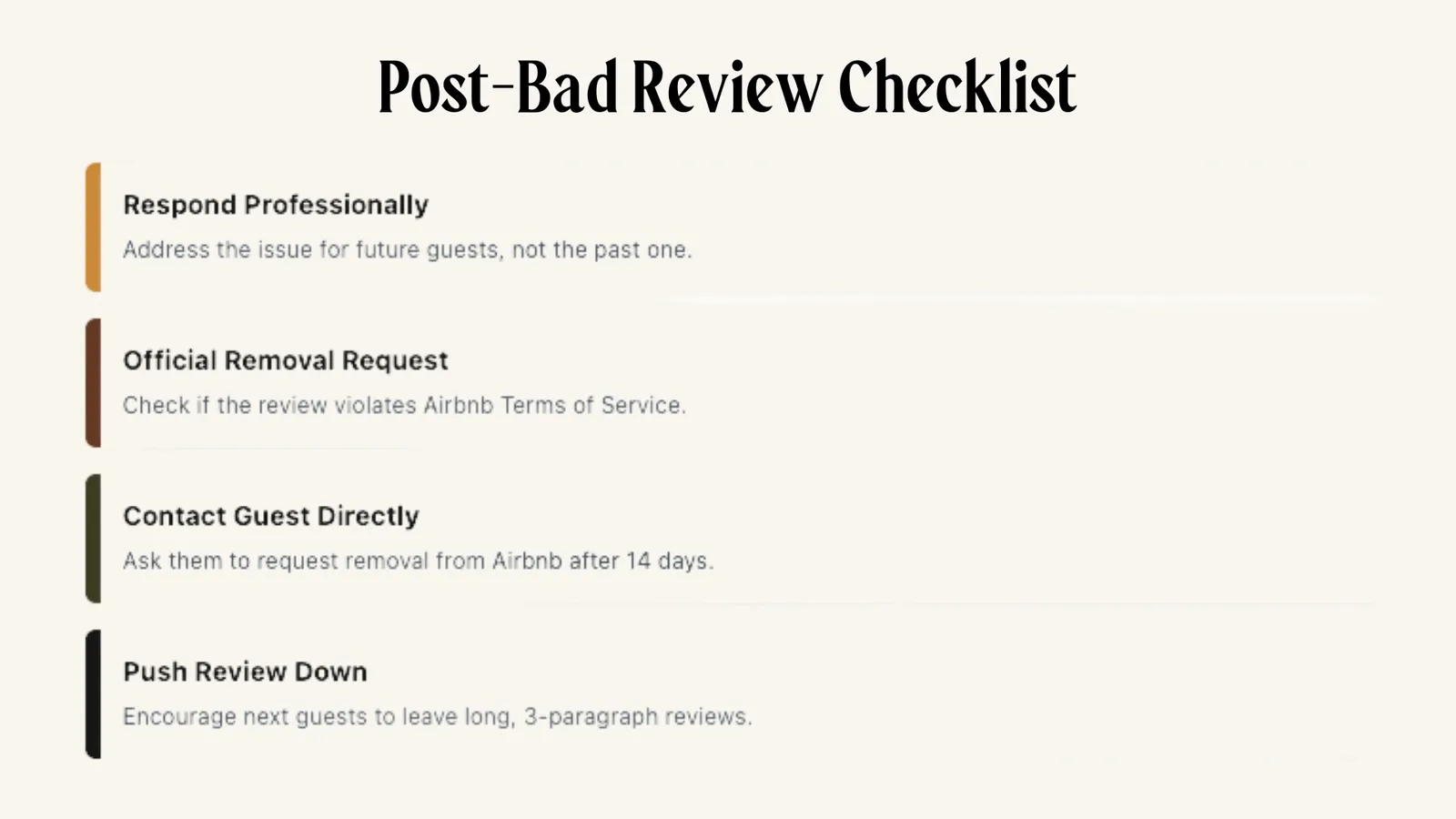
Step 1: Respond Professionally
Write a professional response addressing the issue raised in the review. Don’t be defensive. Acknowledge the problem, explain what you’re doing to prevent it in future, and thank the guest for their feedback.
Remember: you’re not writing this response for the guest who left the review. That guest is gone. You’re writing for future guests who read reviews before booking.
Professional responses demonstrate that you take feedback seriously and continuously improve operations. They mitigate damage by showing prospective guests how you handle problems.
Step 2: Request Official Review Removal
Airbnb has an official process for requesting review removal. Google “how to request Airbnb review removals” to find the current form.
Reviews can only be removed if they violate Airbnb’s terms of service. The review must be relevant to the actual guest stay. Guests can’t leave bad reviews out of retaliation, personal dislike, or reasons unrelated to their experience.
Reviews that contain factually incorrect statements, profanity, personal attacks, or accusations may qualify for removal. Read Airbnb’s review policy carefully to understand what qualifies.
Step 3: Contact the Guest Directly
After the 14-day review window closes, guests can no longer edit their reviews. However, they can contact Airbnb and request removal.
Reach out to the guest privately. Apologize again for the experience. Explain how the review impacts your business. You can mention team members who depend on bookings, or how suspensions cost thousands in lost revenue.
Ask if they would be willing to contact Airbnb and request review removal. Explain that looking back, the review might not accurately reflect their full experience, or they may not have understood the rating system.
If the guest agrees and contacts Airbnb directly, the platform usually removes the review. Requests from guests carry significantly more weight than requests from hosts.
You can offer incentives: additional refunds, free future stays, or other compensation. Some operators have excellent success with this approach.
Step 4: Push Bad Reviews Off the Front Page
Airbnb displays approximately six reviews on your listing’s front page. These are the “most relevant” reviews according to Airbnb’s algorithm.
Even if you get several good reviews after a bad one, it doesn’t automatically push the bad review down. Airbnb determines relevance based on factors including review length, detail, and recency.
To push a bad review off the front page:
- Encourage every subsequent guest to leave detailed, long reviews
- Ask guests to write three paragraphs rather than one sentence
- Detailed reviews have higher chances of being considered “relevant”
- The more relevant reviews you accumulate, the faster bad reviews move down
Most guests only read the six reviews shown on the front page. Some dig deeper, but the majority make decisions based on visible reviews. Getting bad reviews pushed down reduces conversion damage significantly.
Real-World Example: Maintaining 4.9+ Ratings in Mountain Markets
Freewyld operates cabins in Idyllwild, California, a mountain market with significant operational challenges. The portfolio maintains ratings above 4.9 across all listings.
The properties face:
- Mountain weather with storms and heavy snow
- Power outages from severe weather
- Fire season closures and evacuations
- Equipment failures from extreme temperature fluctuations
- Road closures affecting guest access
Despite these challenges, ratings remain consistently high. The difference is systems.
Cleaners report issues immediately during turnovers. The team communicates proactively with guests about mountain weather conditions and what to expect. When power outages occur, guests receive calls (not just messages) with updates and estimated restoration times.
When problems can’t be prevented, the team focuses on making guests feel cared for. Guests understand that mountain weather happens. What matters is knowing that someone is actively working to resolve issues and genuinely cares about their experience.
This example demonstrates that high ratings don’t require perfect conditions or problem-free operations. High ratings require systems that catch preventable problems early and handle unavoidable problems with transparency and care.
Why Channel Diversification Matters More Now
With Airbnb’s increased focus on quality enforcement and listing removals, depending solely on Airbnb creates business risk.
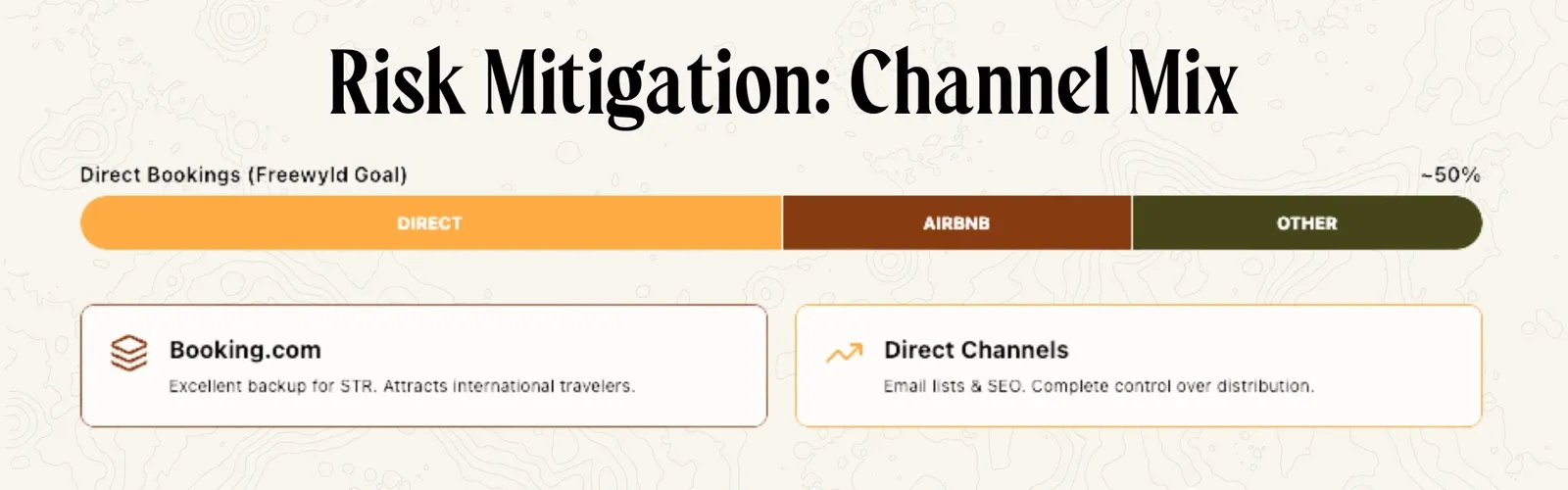
Freewyld now generates close to 50% of bookings through direct channels. Several client properties that faced Airbnb suspensions still maintained similar revenue levels by filling gaps with Booking.com, VRBO, and direct bookings.
Booking.com as a Backup Channel
Booking.com is becoming a stronger channel for short-term rentals. The platform is more complex to set up initially, with a steeper learning curve during onboarding. However, once configured properly, it generates consistent bookings.
Booking.com tends to attract different guest demographics, including more international travelers. Setting up properly requires understanding their unique requirements and policies.
If you’re not currently on Booking.com, consider adding it as a distribution channel. The platform can partially or fully replace Airbnb revenue if suspensions occur.
Building Direct Booking Channels
Direct bookings eliminate platform dependency entirely. Building email lists, investing in SEO, and creating optimized booking websites takes time and effort. The payoff is complete control over your distribution.
Operators with strong direct booking channels weather platform policy changes, algorithm updates, and suspension risks more effectively than those dependent on single platforms.
Summary & Key Takeaways
Airbnb listing suspensions are increasing as the platform prioritizes quality over quantity. Operators need prevention systems to maintain high ratings and avoid flags, suspensions, and permanent removal.
Key prevention systems:
- Train cleaners to report broken amenities during turnovers before guests arrive
- Communicate proactively with guests to set clear expectations
- Go beyond clean and functional by looking for small ways to improve experiences
- Respond quickly and transparently when problems occur, making guests feel genuinely cared for
- Educate guests about Airbnb’s rating system to prevent unintentional damage
- Respond professionally to bad reviews and use official removal processes
- Contact guests directly after 14 days to request review removal from Airbnb
- Push bad reviews off front pages by encouraging detailed, long reviews from subsequent guests
- Diversify distribution channels to reduce dependency on Airbnb alone
Maintaining ratings above 4.9 across large portfolios is possible. The difference isn’t avoiding problems. The difference is building systems that catch problems before guests experience them and handling unavoidable problems with care and transparency.
Next Steps
Prevention systems protect your business from costly suspensions and permanent platform removal. The operators maintaining the highest ratings at scale have built systematic approaches to guest experience, not occasional gestures.
Start by auditing your current cleaner reporting process. Do cleaners flag broken amenities before guests arrive, or do guests discover problems first? This single change prevents more bad reviews than any other intervention.
Then evaluate your guest communication. Are you setting clear expectations before arrival and checking in proactively during stays? Small communication improvements create significant rating improvements.
Questions for discussion:
What prevention systems have worked best for your portfolio? Have you successfully recovered from bad reviews or suspensions? Share your experience in the comments below.
If you’re interested in learning more about revenue management systems that protect and grow your STR business, apply for a free revenue report at freewyldfoundry.com/report.
Internal Links:
- What 4.9-Rated Properties Do Differently (Based on Real Guest Reviews) https://freewyldfoundry.com/ep693-real-guest-reviews/
- 1,000+ 5-Star Airbnb Reviews: What It Took https://freewyldfoundry.com/ep680-5-star-airbnb-reviews/
- Scaling to 100+ STR Units Without Compromising Quality https://freewyldfoundry.com/ep687-scaling-to-100-units/
- How to Maintain 4.9 Star Airbnb Reviews Across Large Portfolios https://freewyldfoundry.com/4-9-star-airbnb-reviews/
- How to Get 5-Star Airbnb Reviews: Simple Strategies That Actually Work in 2025 https://freewyldfoundry.com/airbnb-reviews/
External Links:
- Airbnb’s Official Listing Suspension and Removal Policy https://www.airbnb.com/help/article/1303
- Airbnb’s Official Reviews Policy https://www.airbnb.com/help/article/2673
- How to Remove a Review from Airbnb (Official Process) https://www.airbnb.com/help/article/3582
- Unreasonable Hospitality by Will Guidara https://www.amazon.com/Unreasonable-Hospitality-Remarkable-Giving-People/dp/0593418573
- Understanding Booking.com for Short-Term Rental Hosts https://hosttools.com/blog/short-term-rental-tips/booking-com-fees/