Introduction
What if the key to scaling your short-term rental business isn’t finding the next hot market, but becoming the absolute expert in the one you’re already in?
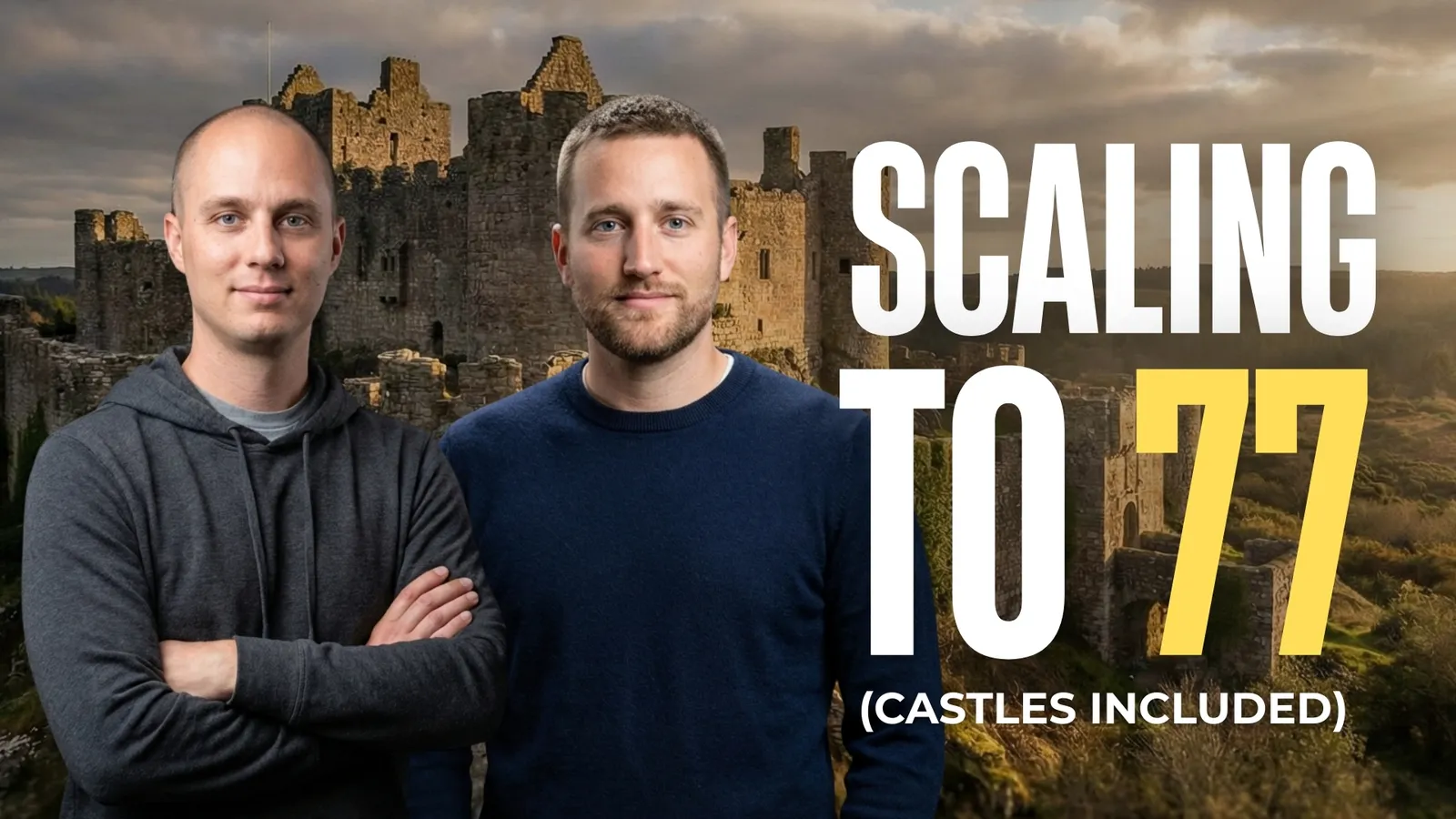
Dave Stokley and Mark from Host Pros manage 77 properties across Ohio. They maintain a 4.8+ guest rating. They’ve bought castles with just 5% down. (Yes, castles. In Ohio.) And when someone offered them a property to manage in California last year, they turned it down.
Their reasoning challenges everything most STR operators believe about growth and expansion.
In this conversation with Eric Moeller on the Get Paid For Your Pad podcast, Dave and Mark break down their entire approach to building a property management company that doesn’t just participate in their market but dominates it. You’ll learn why they chose depth over breadth, how unreasonable hospitality creates premium pricing power, and what it actually means to know a market so well that competition becomes irrelevant.
If you’re managing properties in what others might consider a “boring” market, or if you’ve been wondering whether you need to expand geographically to scale, this breakdown will give you a completely different framework to think through those decisions.
The “We Don’t Compete, We Dominate” Philosophy
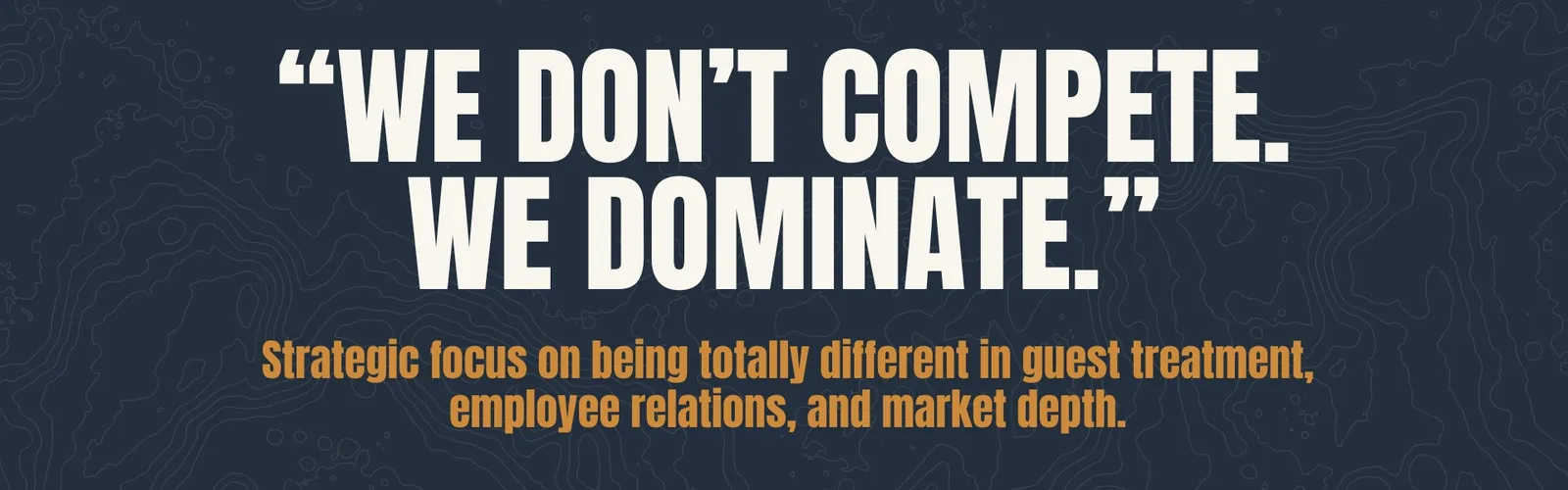
Host Pros operates with a clear number one company value: “We don’t compete. We dominate.”
This isn’t just motivational language on a wall. It’s the strategic foundation of how they make every business decision.
Dave explained it this way: “We don’t want to have competition. We want to be totally different in everything from the way we treat our guests to our employees and everything in between.”
Most STR operators think about growth in terms of geographic expansion. Add a property in Nashville. Try Miami. Test out Scottsdale. The assumption is that more markets equals more opportunity.
Dave and Mark took the opposite approach. They went deep in Ohio. They learned every street, every neighborhood, every seasonal pattern, every type of property that performs well in their specific market. That depth of knowledge became their competitive advantage.
When you know a market that deeply, opportunities show up differently for you than they do for everyone else. A property that looks average to someone scanning Zillow from another state looks like a goldmine to someone who understands the specific demand patterns in that neighborhood.
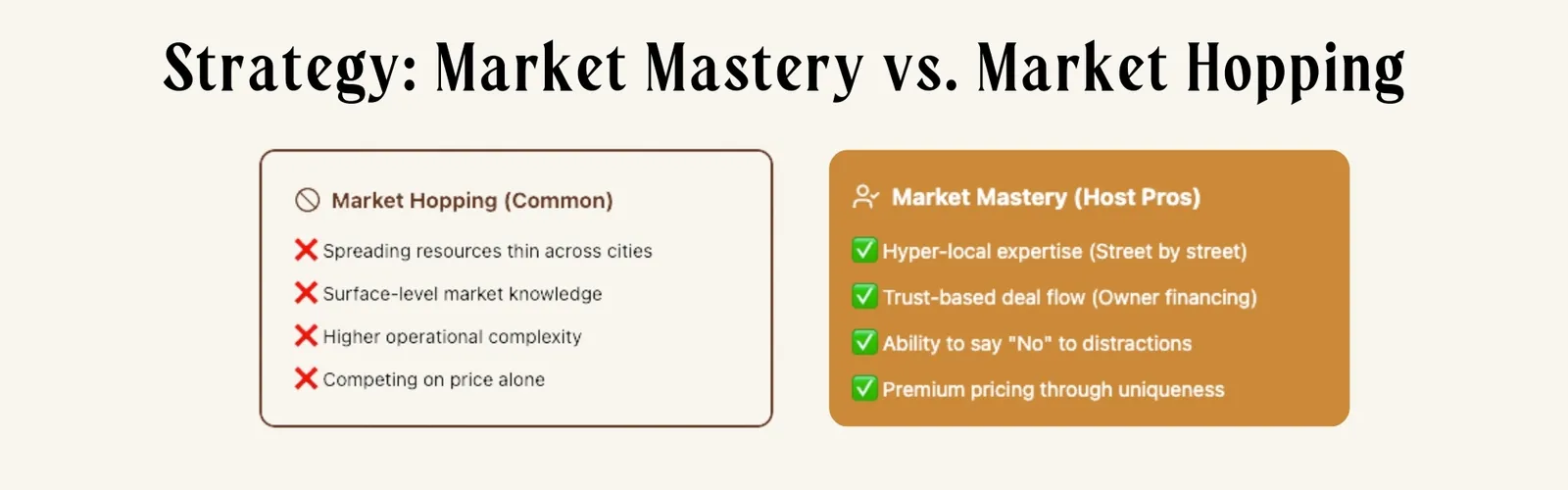
Why Market Mastery Beats Market Hopping
Dave sees opportunities on Zillow every single day that he knows would perform exceptionally well. He can identify them instantly because he understands which streets work, which property types fill fastest, and what guests in his market will pay premium rates for.
That level of expertise doesn’t come from spreadsheets or market analysis reports. It comes from being in the same place long enough to see patterns, understand demand shifts, and recognize opportunities the moment they appear.
Here’s what market mastery actually creates in practice:
Deal Flow That Others Miss
When Dave and Mark wanted to buy their wizard-themed castle property, they were able to negotiate owner financing with just 5% down. The seller agreed because they trusted the local expertise Dave and Mark had built over years of operating in that market.
That deal wouldn’t have been possible if they were operators from another state trying to expand into Ohio. The relationship, the trust, and the local reputation made it work.
Equity Partnerships with Existing Clients
Because clients see how well Host Pros operates their properties, some have approached Dave and Mark about going into partnership deals together rather than traditional management agreements.
One client they’d been managing for three years saw a property opportunity down the road from his existing listing. Dave sent him the link. The client barely hesitated before agreeing to a 50-50 partnership where he provides capital and Host Pros handles all operations.
That opportunity came directly from the trust built through consistent local performance.
The Ability to Say No to Distractions
About a year before buying the Ohio castle, the same client asked Dave and Mark to manage a property for him in California. They said no.
That decision might seem counterintuitive when you’re trying to grow. But for Host Pros, it was completely aligned with their strategy. They don’t want to be adequate operators in ten markets. They want to be the absolute best in one.
\
The Role of Unreasonable Hospitality in Premium Positioning
Host Pros doesn’t just compete on operations and pricing. They’ve built their business around creating experiences that guests remember long after checkout.
Dave put it this way: “We’re not just renting properties. We’re creating lifelong memories for people.”
That philosophy shows up in everything from how they train their cleaning teams to the experiential details they’ve built into their properties.
The Wizard Portrait System
Their wizard-themed castle property (called the School of Sorcery) includes a guest experience element that perfectly illustrates their approach to hospitality.
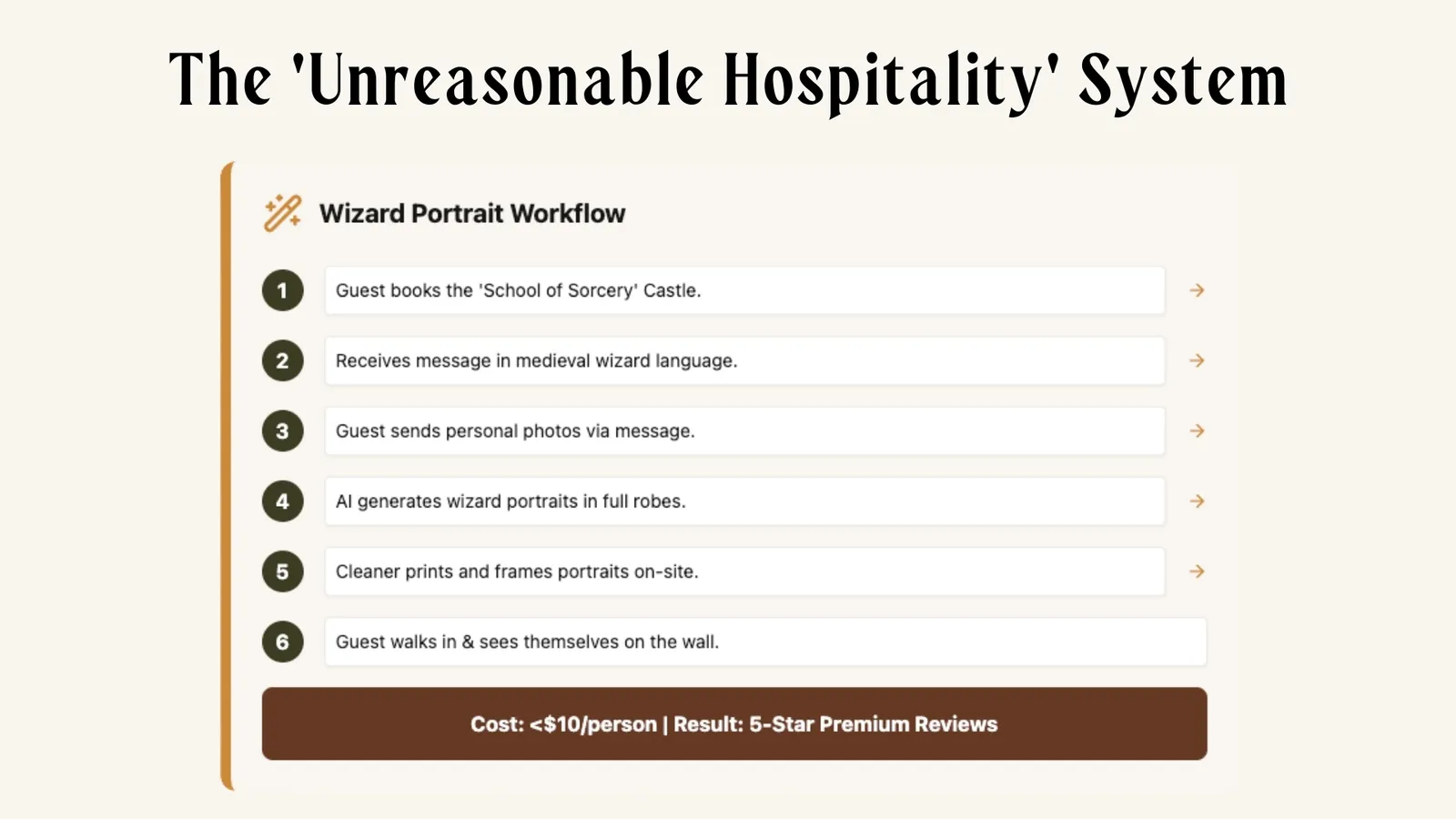
When someone books the castle, they receive a message that’s written entirely in medieval wizard castle language. Everything in the guest communication maintains that theme.
One of those messages invites guests to send photos of themselves and anyone traveling with them. The Host Pros team then uses AI to generate wizard portraits of each guest in full robes, prints them, frames them, and hangs them on the wall before the guests arrive.
The first thing you see when you walk into the property is yourself on the wall in wizard robes, ready for your stay.
Guests take the framed portraits home as souvenirs. The cost is less than $10 per person. But the experience creates the kind of memorable moment that justifies premium rates and generates enthusiastic five-star reviews.
Why Small Details Create Big Results
Most operators dismiss experiential details like this as “extra work” that doesn’t move the needle on performance.
Dave and Mark prove otherwise. These details are what separate operators who compete on price from operators who can charge premium rates.
The wizard portraits aren’t complicated to execute. The cleaner receives the photos, prints them on the wifi printer that’s already at the property, puts them in frames that are stocked on site, and hangs them before the guest arrives.
It’s a system. Once it’s built, it runs smoothly. And it creates differentiation that can’t be replicated by operators who think hospitality means clean sheets and stocked coffee.
How to Maintain 4.8+ Ratings at Scale
One of the most impressive aspects of Host Pros’ operation is that they’ve maintained a 4.8+ rating across 77 properties.
That level of consistency at scale is rare. Many operators see their ratings drop as they grow because systems break down, standards slip, or the focus shifts from guest experience to pure operational efficiency.
Host Pros has avoided that trap by treating every stay as a promise.
Dave explained their approach to training team members: “Someone rents a house, a lake house from us for a week in the summer. They might’ve been saving up their money for an entire year to spend a week at our house. And if they show up and it’s dirty or the AC doesn’t work or the hot tub doesn’t work or something like that, that sucks. I don’t want to ruin someone’s vacation like that.”
That mindset extends to situations most operators don’t think about. Sometimes Host Pros hosts people who are in town for a funeral, or whose family member is in hospice at the local hospital. Those guests rent a property so their family can be together during a difficult time.
The last thing they need is a place that isn’t being taken care of properly.
This perspective, that every stay matters regardless of the reason someone is traveling, keeps the team focused on delivering consistent excellence.
Building a Partnership That Lasts
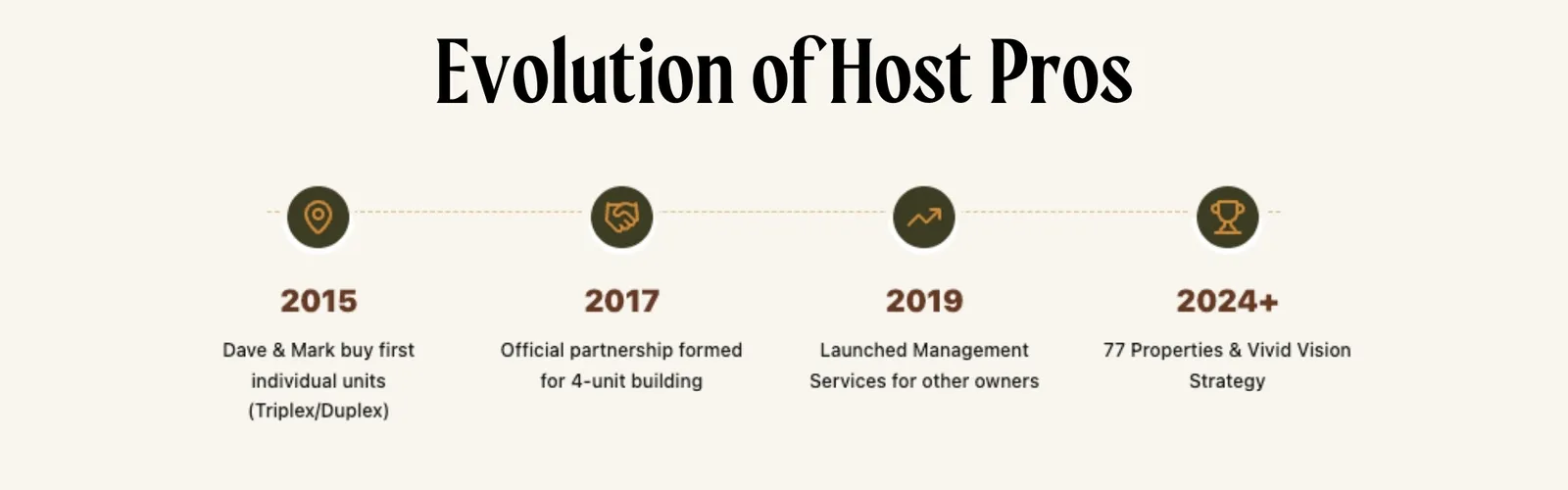
Dave and Mark have been business partners since 2015. They started by each buying their first investment properties that year (Dave bought a triplex, Mark bought a duplex), realized they had similar goals, and decided to partner on a four-unit apartment building in 2017.
That’s when they started experimenting with Airbnb. Mark had been renting out rooms in his apartment (old school OG Airbnb style), so they decided to try listing a couple units in their building.
By 2019, they felt confident enough in their systems to start offering property management services to other owners. They’ve been growing deliberately since then.
Why Their Partnership Works
When asked about what makes their partnership successful over nearly ten years, Mark pointed to shared values as the foundation.
“I look at a business partnership very similar to a marriage,” Mark explained. “Dave and I spend a lot of time together. We talk all the time. We’re friends as well as business partners, which helps. But when we met, we didn’t know each other. So we got to know each other, learned about each other’s values, what we wanted to achieve in our lives.”
They didn’t partner because one had money and the other had skills. They partnered because they had aligned views on how to run a business, how to approach their team, how to handle conflict, and how to handle success.
Mark emphasized that last point particularly: “How do we show up together in times of success as well? I think a lot of people, business owners, we don’t talk about that.”
The Vivid Vision Exercise
At the beginning of 2024, Dave and Mark went through the Vivid Vision exercise (created by Cameron Herold) to document their long-term vision for the company.
They wrote out what the company looks like when they’re making a million dollars in profit. What are they doing? What is Mark doing? Who’s on the team? What do team members do? Where do they go for retreats? How much do employees get paid? What are the benefits?
By doing that work upfront, they created alignment on where they’re heading and what success actually looks like for both of them. That shared vision makes it easier to navigate the inevitable ups and downs of building a business.
Real-World Example: The Castle Deal
The wizard-themed castle property illustrates how all of Host Pros’ strategies work together in practice.
Dave and Mark were already managing an urban castle property for a co-hosting client in Cleveland. The property performed exceptionally well despite being in an average neighborhood. The booking metrics on Airbnb were strong, tons of views, high conversion to bookings.
They realized the uniqueness of the property itself was creating demand.
Around that same time, Dave’s cousin (a realtor) mentioned that someone in his wife’s family had an old church that had been converted into a castle in rural Ohio. It had been listed for sale, didn’t sell in six months, and was taken off the market.
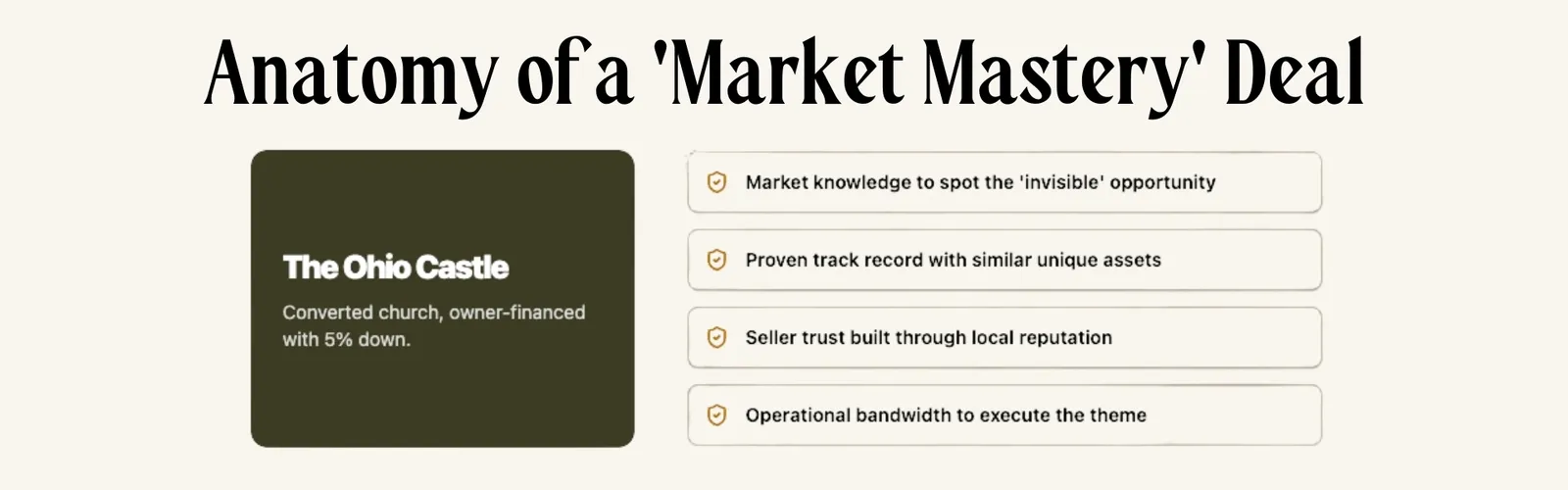
Dave and Mark looked at the property and immediately saw the potential. They were able to work directly with the seller and structure an owner-financed deal with just 5% down and a very low interest rate.
They closed in April 2025, invested heavily in design to create a full wizard theme, and launched in September 2025. The property has been performing well in its first four months of operation.
This deal only happened because:
- They understood their market well enough to recognize the opportunity
- They had proven track record managing a similar property type
- The seller trusted their local expertise enough to offer favorable financing terms
- They had the focus and bandwidth to execute the renovation properly
- They built experiential systems (like the AI portraits) that justify premium pricing
None of this would have been possible if they were stretched across ten markets trying to manage everything remotely.
What Success Actually Means
Both Dave and Mark acknowledged that defining and measuring success is more complex than hitting revenue targets.
Mark framed it this way: “Success is, are we living our values? We have five company values. Are we living that out in what we do? As long as we’re doing that, I feel like we are successful because then the numbers, the money, everything will come from that.”
Dave admitted he’s not particularly good at celebrating success. His standards and goals are always rising. But he also recognizes the importance of acknowledging what they’ve built: full-time employment for 10 people, work for dozens of cleaners, helping those people accomplish their goals.
He also finds satisfaction in the work itself: “There are times when I’m driving and I’m going to meet three different clients all over the state. And I just think to myself, this is awesome. I love this. I’m happy I get to do that.”
This perspective aligns with Morgan Housel’s concept in The Psychology of Money about the importance of not constantly moving the goalposts. Financial happiness and discipline come from being satisfied with where you are in the journey while still working toward growth.
Key Takeaways
Here are the core strategies that allowed Host Pros to scale to 77 properties in one market:
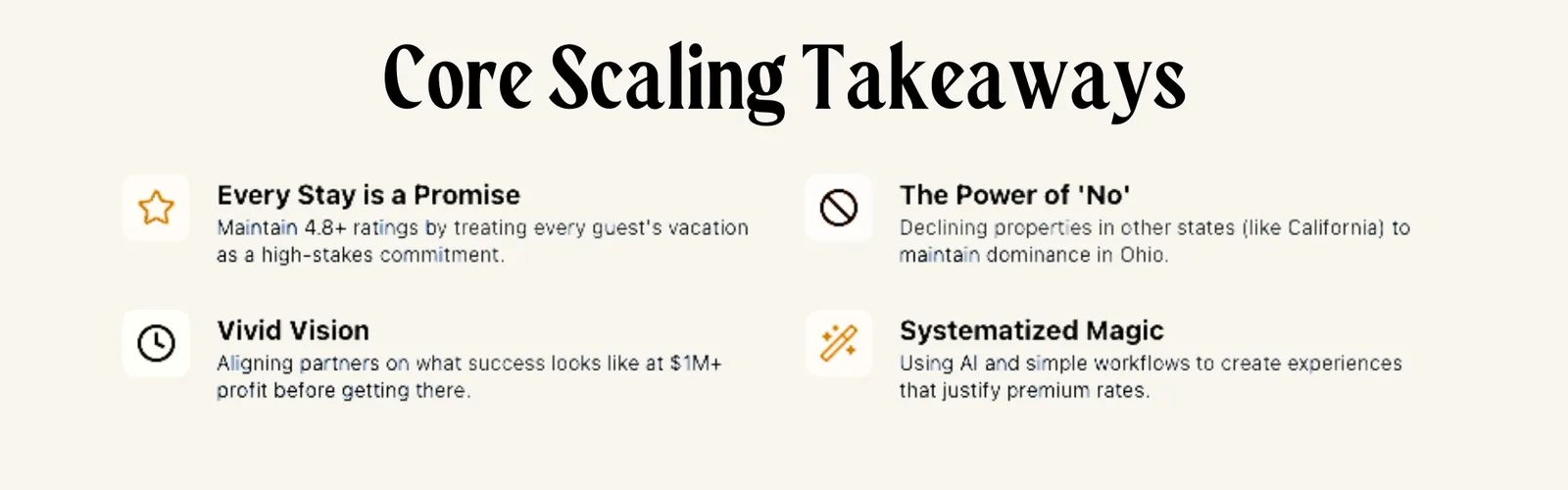
- Master one market instead of dabbling in ten. Deep market knowledge creates opportunities that others can’t see and relationships that lead to favorable deals.
- Build unreasonable hospitality into your systems. Small experiential details justify premium rates and create word-of-mouth marketing that paid advertising can’t replicate.
- Maintain focus by saying no to distractions. Geographic expansion might seem like the obvious path to growth, but depth often creates more value than breadth.
- Treat every stay as a promise. Consistent excellence at scale requires viewing each booking as a commitment to create a great experience, regardless of why the guest is traveling.
- Partner with people who share your values. Business partnerships work when they’re built on aligned values and vision, not just complementary skills or capital.
Next Steps
If you’re managing properties and wondering whether you need to expand into new markets to grow, consider Host Pros’ approach. What would it look like to become the absolute expert in your current market instead?
Start by identifying the patterns in your market that others might not see. Which neighborhoods perform better than expected? Which property types have the strongest demand? What amenities do guests in your area value most?
Then ask yourself: what experiential details could you add to your properties that would create memorable moments without adding significant operational complexity?
Questions for discussion: Are you currently focused on one market or spread across several? What would it take for you to become the recognized expert in your area?
Internal Links
Podcast Episode Links:
- Ep637 – How Troy Daily Scaled to 70+ STRs (and Kept His Sanity)
https://freewyldfoundry.com/ep637-how-troy-daily-scaled-to-70-strs-and-kept-his-sanity/ \
- Ep680 – 1,000+ 5-Star Airbnb Reviews: What It Took
https://freewyldfoundry.com/ep680-5-star-airbnb-reviews/ \
- Ep689 – From Hurricane Loss to 70 Rentals: Scaling STR Business
https://freewyldfoundry.com/ep689-scaling-str-business/
Article Links: \
- How Troy Daily Scaled to 95+ Short-Term Rentals While Maintaining Quality Standards
https://freewyldfoundry.com/short-term-rentals-troy/ \
- How to Get 5-Star Airbnb Reviews: Simple Strategies That Actually Work in 2025