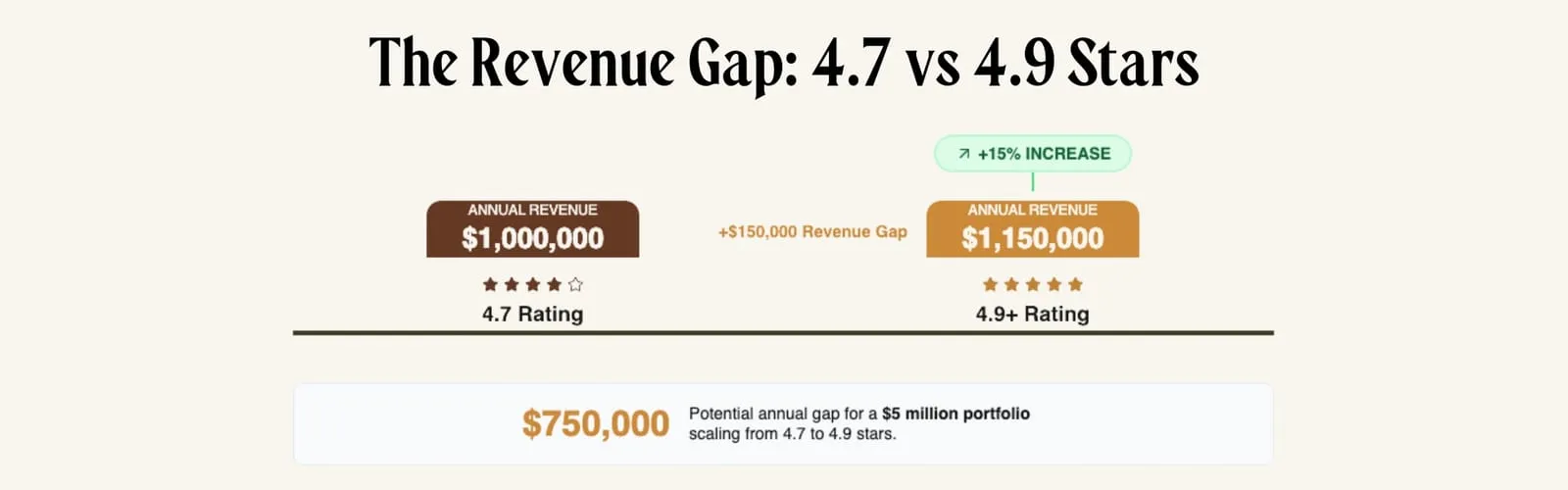
What’s the real difference between a 4.7-star Airbnb rating and a 4.9-star rating?
According to AirDNA’s research, the average increase is 15%. For a portfolio generating $1 million in annual bookings, that translates to $150,000 left on the table. Scale that to a $5 million portfolio, and you’re looking at a $750,000 gap.
The question is: what creates that difference?
We recently analyzed hundreds of 4.9-rated Airbnb listings, each with hundreds of verified reviews. These weren’t just individual properties. They maintained exceptional ratings across multiple markets and dozens (sometimes hundreds) of listings.
What we discovered challenges the common assumption that scaling kills quality. The operators maintaining 4.9 stars at scale were using specific systems that protect the guest experience even as they grow.
In this article, we’ll break down the four core attributes that guests consistently mention in 4.9-star listing reviews, share real examples from operators managing massive portfolios, and give you actionable steps to implement these strategies in your own business.
Why 4.9 Stars Matter More Than Ever for Airbnb Hosts
The short-term rental industry is evolving rapidly, and professional operators are becoming the new standard.
At a recent Airbnb host summit, Brian Chesky made it clear that the platform is shifting toward incentivizing hosts with 4.9 stars or higher while devaluing hosts who consistently fall below that threshold. While Airbnb didn’t provide exact details on how this will play out, we can make educated guesses: placement penalties, reduced visibility, and potentially being removed from the platform entirely.
This isn’t just about Airbnb’s preferences. It’s about what guests expect.
Travelers today are fatigued with automated, impersonal stays that feel transactional. They want a connection. They want to feel valued. And when they don’t get that experience, they remember it in their reviews.
The operators who thrive in this environment understand that efficiency at scale cannot come at the expense of hospitality. You can have both, but only if you build the right systems.
The Research: What Guests Actually Say in 4.9-Star Reviews
We pulled hundreds of 4.9-rated Airbnb listings and analyzed their reviews.
We weren’t looking for what we thought mattered. We wanted to understand what guests actually said mattered to them. What was so top of mind that they took the time to mention it in a review?
Four clear patterns emerged. None of them were about amenities. None of them were about having the biggest budget or the most unique property.
They were about feelings.
How guests felt when they checked in. How they felt when something went wrong. How they felt when they left.
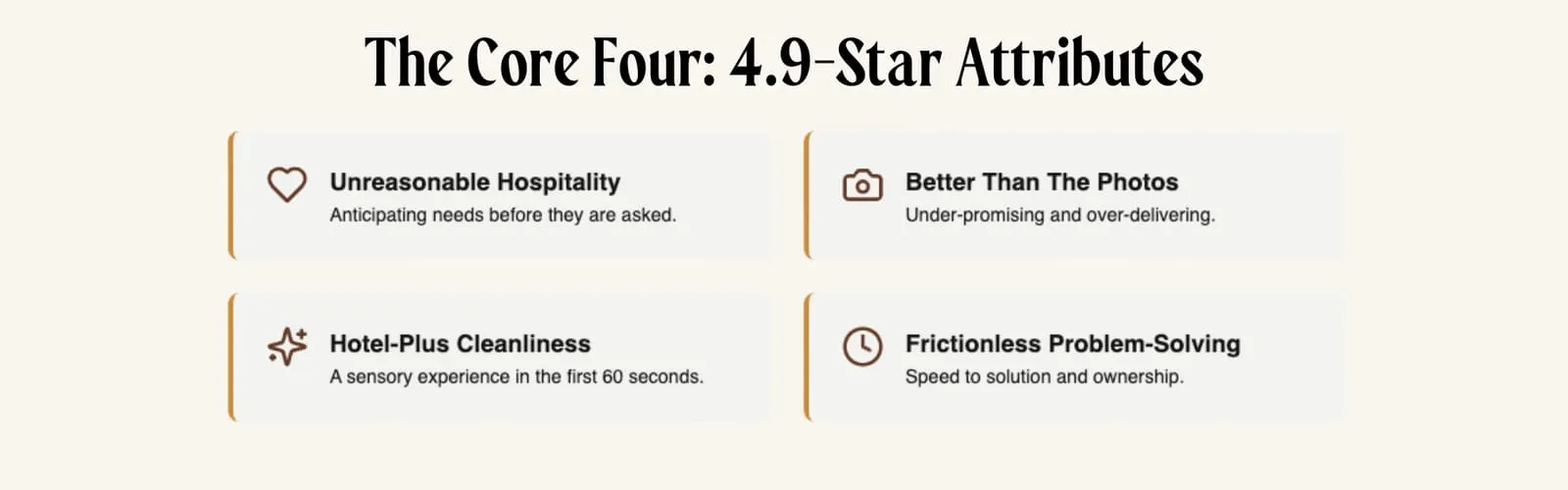
These four attributes appeared over and over again in the language guests used to describe their experiences at top-rated properties.
The Core Four: Attributes Behind Every 4.9-Star Portfolio
Attribute #1: Unreasonable Hospitality
The first pattern we identified is what we call “unreasonable hospitality.” This term comes from the idea that great hospitality goes beyond what’s expected or even what’s asked for.
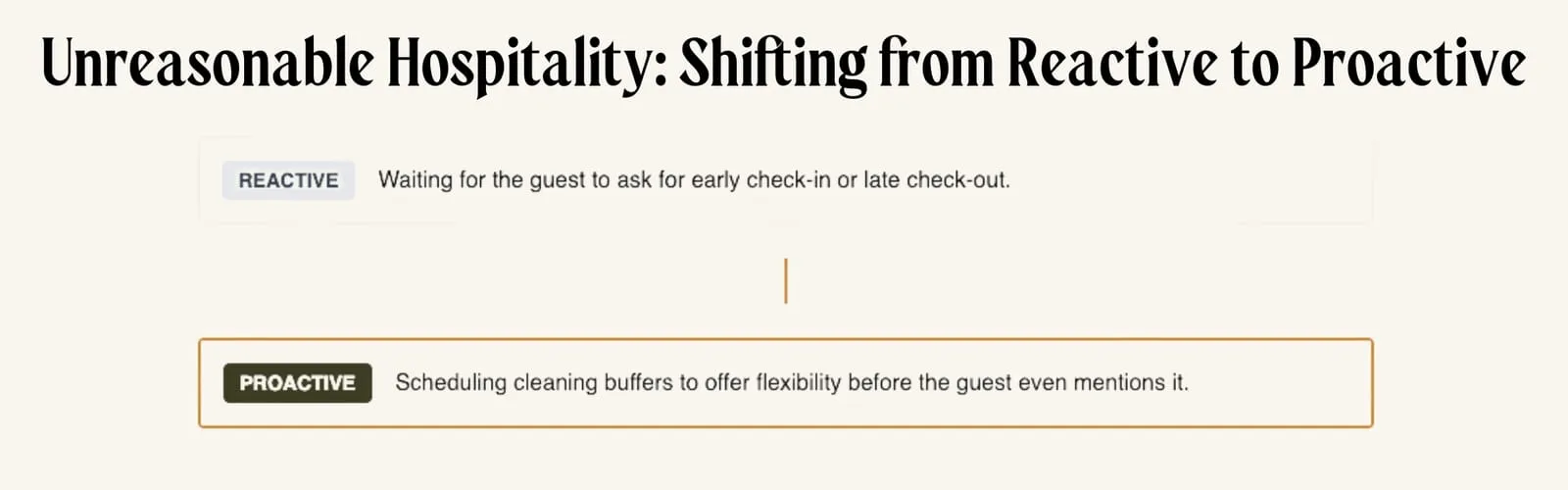
Guests at 4.9-star properties mention hosts who anticipated their needs before they even had to ask. Early check-ins were already arranged. Late checkouts were offered proactively. Problems were resolved before they became complaints.
One review we came across said: “They reached out the next morning just to make sure everything was perfect. I didn’t even have to ask.”
This is the difference between reactive customer service and proactive hospitality.
How to implement this at scale:
At Freewyld, we know that nearly every guest will request early check-in or late checkout. Instead of waiting for them to ask, we schedule our cleaning team to anticipate these requests. We create buffer windows that allow guests to check in an hour early and check out an hour late without disrupting operations.
If they don’t need the extra time, our team gets in early to clean. If they do need it, we’ve already built flexibility into the schedule.
This simple shift removes friction and makes guests feel like their needs were understood before they even voiced them.
Another powerful example comes from Beth Palmer of Northridge Escapes, who has earned over 1,000 five-star reviews across her portfolio. She still manages guest communication herself because she views every interaction as an opportunity to create a human connection. When a guest mentions they’re celebrating a birthday or anniversary, she makes sure to acknowledge it personally.
The key insight here: Optimize for connection, not just efficiency. Use technology to enhance your team’s ability to personalize experiences, but don’t let automation replace the human touch entirely.
Attribute #2: Better Than the Photos
The second attribute consistently appearing in 4.9-star reviews is guests’ descriptions of properties that exceed their expectations based on the listing photos.
Common phrases include: “The photos don’t do it justice” or “It’s even bigger than it looks online.”
This isn’t about having better photography (though quality photos matter). It’s about the philosophy of under-promising and over-delivering.
The strategy:
Show the basics in your listing. Give guests everything they need to make an informed booking decision. But save a few surprises for when they arrive.
At Freewyld, we have what we call a “Wyld Mode” box. It’s filled with goodies and experiences that enhance the stay. We hint at it in the listing and show it in photos, but we don’t reveal all the contents. When guests discover what’s inside, it feels like getting more than they paid for.
Some properties take this further with hidden rooms, speakeasies, or unexpected amenities that aren’t heavily promoted in the listing but become highlights in guest reviews.
Where this breaks down:
The challenge with this attribute isn’t the surprise factor. It’s maintenance.
If your listing photos show a beautiful fire pit, pristine furniture, and spotless interiors, but guests check in to find broken chairs, blown-out lights, or amenities that don’t work, you’ve created a negative surprise instead of a positive one.
We learned this lesson firsthand when a guest wanted to use our fire pit and discovered it was broken. Our maintenance team hadn’t reported the issue, and we didn’t have a system in place to catch it before the guest did.
That single oversight could have cost us a five-star review.
The solution:
Build obsessive maintenance systems. Train your cleaning and maintenance teams to report issues the moment they notice them. Don’t wait for guest feedback to identify problems. By then, you’ve already lost the review.
Operators maintaining 4.9 stars across hundreds of properties have learned to catch these issues before guests experience them. They shut down properties quarterly to repaint walls, replace worn furniture, and fix small details that accumulate over time.
Details matter. Guests feel them even if they don’t consciously register them.
Attribute #3: Hotel-Plus Cleanliness Standards
Cleanliness is the baseline. Every guest expects a clean property. But 4.9-star properties go beyond clean.
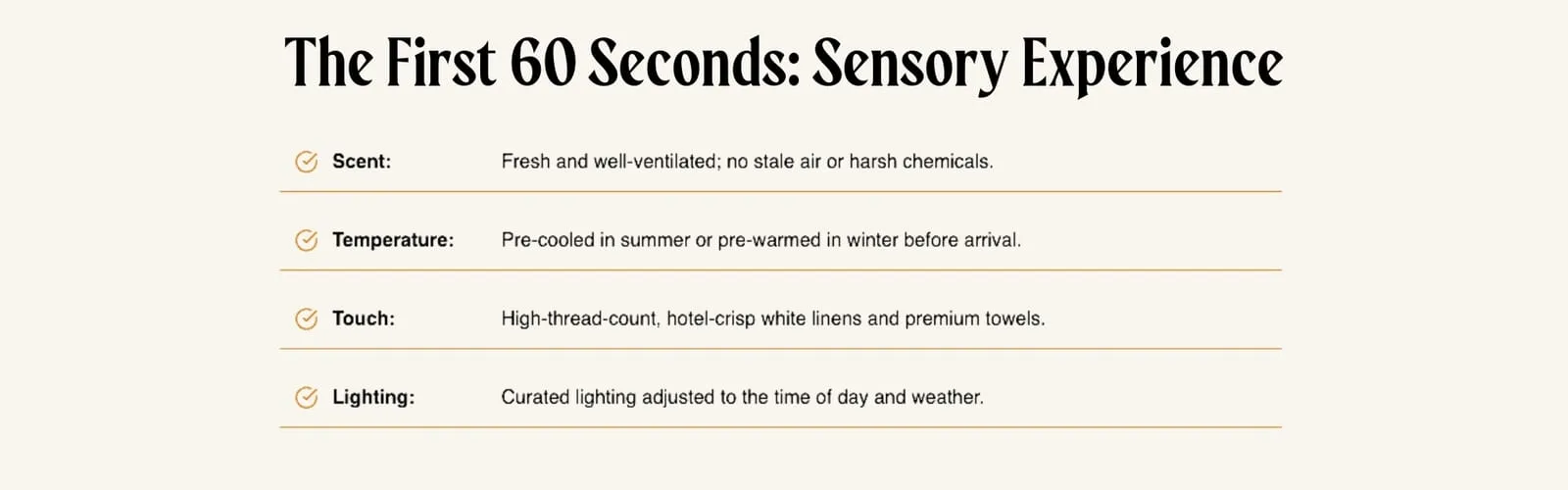
They create a sensory experience in the first 60 seconds after a guest walks through the door.
What guests mention in reviews:
“It smelled amazing as soon as we walked in.” “The linens felt brand new.” “The AC was already on and set to the perfect temperature.”
This is about creating an emotional impression that shapes the entire stay.
High-end hotels, restaurants, and retail stores have understood this for decades. They invest heavily in understanding what a space should smell like, how the lighting should be adjusted throughout the day, and how to eliminate friction points that disrupt the guest experience.
One of our friends, who owns several restaurants in San Diego, spends the first part of his day walking through each location and adjusting the lighting based on the weather. If it’s cloudy, he adjusts. If it’s bright, he adjusts. As the sun sets, he adjusts again.
When you walk into his restaurant, you feel it. Everything is curated to create a seamless experience.
How to apply this to short-term rentals:
Start with the basics. Upgrade your linens to high-thread-count, white, crisp sheets that feel premium. Consider bringing laundry in-house to control quality. One operator we know uses a commercial press for their sheets, so they arrive hotel-crisp for every guest.
Move beyond economy products. Stop buying the cheapest toilet paper, the scratchiest towels, and the lowest-quality basics. Guests touch these products every single day of their stay. If you’re cutting corners here, you’re capping your ability to charge premium rates.
Think about scent. What does your property smell like when guests walk in? Stale air and cleaning chemicals don’t create a positive first impression. Consider subtle, high-quality scents, or simply ensure the property is well ventilated and fresh.
Adjust the temperature before guests arrive. If it’s summer, pre-cool the space. If it’s winter, pre-warm it. This small detail makes guests feel like someone cared enough to prepare the space specifically for them.
The investment pays off:
When you invest in quality products and sensory details, you’re not just improving reviews. You’re justifying higher rates. Guests will pay more for properties that feel premium from the moment they arrive.
Attribute #4: Frictionless Problem-Solving
The fourth attribute is frictionless problem-solving.
Here’s the reality: things break. WiFi goes out. Door locks malfunction. Appliances stop working. No property is immune to operational issues.
But guests don’t review you poorly because something went wrong. They review you poorly because you were slow to fix it.
What guests say in 4.9-star reviews:
“The WiFi went out, but the host responded in minutes and had it fixed.” “We had an issue with the lock, but they solved it immediately and were so apologetic.”
The common thread is speed to solution.
The five-minute response standard:
At Freewyld, we have a five-minute response time standard for our customer service team. Any guest message must be acknowledged and responded to within five minutes, and the response must be accurate.
If our team doesn’t know the answer, they escalate it immediately. There’s no delay, no waiting for someone to get back to them later.
This standard creates trust. Guests know that if something goes wrong, they won’t be left hanging.
The golden hour:
When a problem occurs, you have roughly one hour to get moving and fix it. You don’t necessarily need to have it solved within the hour, but guests need to see that you’re actively working on a solution.
This is where the energy you bring to problem-solving matters. When a guest reports an issue, your response shouldn’t sound like “here’s another problem to deal with.” It should sound like “this shouldn’t be happening, I’m on it right now, and I’m going to make sure this never happens again.”
Take ownership. Get excited about solving the problem. Even if you’re tired, even if it’s Saturday night and you just want to relax, the way you show up in that moment determines whether the guest leaves you four stars or five.
Build contingency plans:
One of our clients has built multiple layers of contingencies into his operations. He knows that certain problems will occur because they always do. WiFi outages. Door lock failures. Power issues.
Instead of reacting when these problems happen, he’s built backup plans in advance.
Lock boxes with extra keys in multiple locations. WiFi troubleshooting guides for guests. Backup internet solutions like Starlink. Generator systems for power outages.
By anticipating recurring problems and resolving them in advance, he reduces his team’s operational burden, all while improving the guest experience.
The 1-3% who won’t be satisfied:
There will always be a small percentage of guests who are impossible to satisfy. No matter what you do, they’ll find problems.
We had a guest leave us a two-star review because our walls were too thin and she could hear her kids talking in the other room. We offered earplugs, blankets, and even a second cabin at no charge so she and her husband could separate from the kids. Nothing worked.
Airbnb reviewed the situation and removed the review because they recognized it wasn’t reasonable.
The lesson here is to recognize when you’re dealing with someone who won’t be satisfied no matter what you do. Overload them with care and professionalism, but don’t let those rare experiences dictate how you approach problem-solving for the 97-99% of guests who are reasonable.
Real-World Examples: Operators Maintaining 4.9 Stars at Scale
The operators who’ve figured this out aren’t just managing five or ten properties. Some are managing hundreds.
One operator we’re bringing into our revenue management service manages $20 million in annual bookings across massive South Florida estates. He’s adding 10-15 new properties per month. His portfolio rating? 4.97.
Another client earned over 1,000 five-star reviews across three different markets and refuses to delegate guest communication because she knows every interaction is a chance to create connection.
These operators haven’t sacrificed scale for quality. They’ve built systems that protect the guest experience as they grow.
They’ve hired team members who are obsessed with hospitality. They’ve built maintenance protocols that catch issues before guests experience them. They’ve created communication standards that make guests feel valued.
And they’re reaping the financial rewards. That 15% revenue premium compounds quickly when you’re managing dozens or hundreds of properties.
How to Audit Your Own Portfolio Against These Four Attributes
If you want to improve your ratings, start by auditing your current operations against these four attributes.
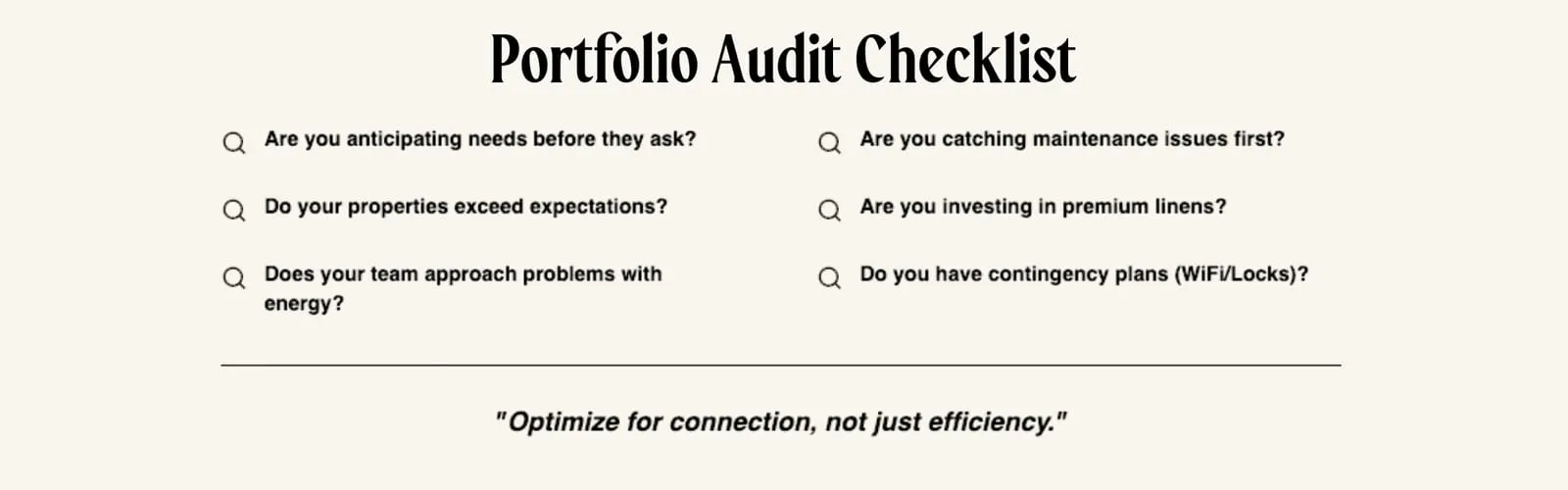
Unreasonable hospitality: Are you anticipating guests’ needs before they ask? Do you have systems in place for common requests, such as early check-ins and late checkouts? Are your team members excited about guests, or do they view hospitality as a burden?
Better than the photos: Does your property match or exceed what guests see in your listing? Are you catching maintenance issues before guests report them? Do you have surprises built in that make guests feel like they got more than they paid for?
Hotel-plus cleanliness: What does your property smell like when guests walk in? Do your linens feel premium? Is the temperature already adjusted? Are you investing in quality products, or are you still buying economy basics to save money?
Frictionless problem-solving: How fast do you respond to guest issues? Do you have contingency plans for recurring problems? Does your team approach problem-solving with energy and ownership, or does it feel like another complaint to deal with?
If you’re falling short in any of these areas, you now have a clear roadmap for improvement.
Summary & Key Takeaways
The gap between 4.7 and 4.9 stars isn’t about luck or having better properties. It’s about building systems that consistently deliver exceptional experiences.
Here are the key takeaways:
- 4.9-star properties earn 15% more revenue than 4.7 or 4.8-rated properties, according to AirDNA research.
- Unreasonable hospitality means anticipating guests’ needs before they ask and creating proactive communication systems.
- Better than the photos is about under-promising and over-delivering, with obsessive attention to maintenance details.
- Hotel-plus cleanliness creates sensory experiences in the first 60 seconds that shape the entire stay.
- Frictionless problem-solving focuses on speed to solution with a five-minute response standard and the golden hour for action.
Operators managing hundreds of properties at 4.97 ratings prove that scaling and quality aren’t mutually exclusive when you build the right systems.
Next Steps: Take Action Now
If you’re managing a large portfolio and want to improve your ratings without sacrificing scale, start by implementing one of these four attributes this week.
Pick the one where you’re falling shortest right now and build a system around it. Train your team. Create accountability. Measure the results.
Many of the CEOs we work with tell us that focusing on guest experience became their favorite part of the business once they delegated revenue management. When you’re not constantly adjusting pricing or second-guessing your strategy, you have the mental bandwidth to obsess over the details that drive five-star reviews.
If you’re generating over $1 million in annual bookings and want to see if you’re leaving revenue on the table with your current pricing strategy, we offer complimentary portfolio audits. Get yours here.
What’s the biggest challenge you face in maintaining high ratings as you scale? Have you implemented any of these four attributes in your own portfolio? Share your experiences in the comments below.
Internal Links:
-
Ep681 – FIFA World Cup Draw: Which Cities Will Profit the Most
-
Ep679 – 2026 Pricing Strategies Every Short-Term Rental Operator Must Use
https://freewyldfoundry.com/ep679-str-pricing-strategies-2026/
-
Ep667 – Airbnb 2026: How Pro Hosts Will Dominate the Game
External Links:
- Hostaway – “4 Revenue Management Best Practices for Short-Term Rentals”:
https://www.hostaway.com/blog/revenue-management-best-practices/ - FIFA World Cup 2026 Official Schedule: https://www.fifa.com/en/tournaments/mens/worldcup/canadamexicousa2026