The Goal Setting Trap Most Entrepreneurs Fall Into
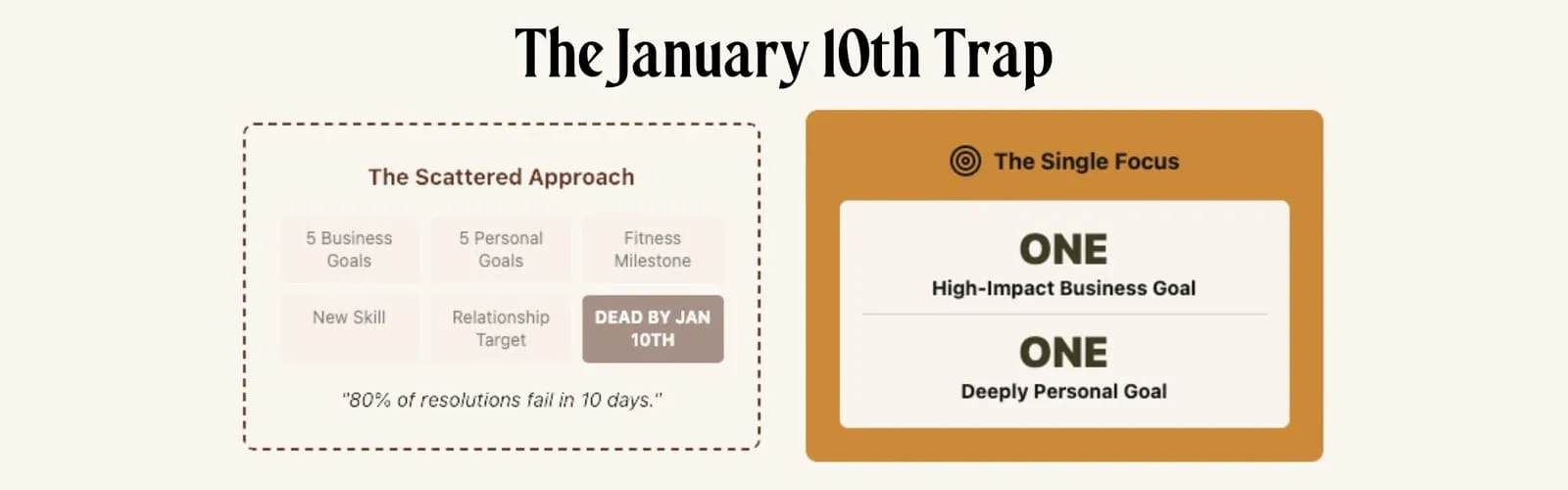
You’ve been there before. End of December rolls around, and you’re pumped. You map out 5 business goals, 5 personal goals, fitness milestones, relationship targets, and maybe throw in learning a new skill for good measure. Fast forward to January 10th (yes, specifically the 10th), and 80% of those resolutions are already dead in the water.
Here’s what you’re going to learn in this article: a proven framework for single focus goal setting that replaces the scattered “do everything” approach with strategic simplicity. You’ll discover the four essential elements that turn ambitious visions into accomplished realities, complete with real examples from scaling a revenue management company from the ground up. Most importantly, you’ll understand why energy management, not just time management, determines whether you actually achieve your goals.
This isn’t another motivational pep talk. This is the distilled wisdom from over a decade of goal setting successes and failures in the short-term rental and hospitality space.
Why Most Goal Setting Strategies Fail
We’ve all heard the saying: you overestimate what you can accomplish in a year but underestimate what you can do in ten years. That’s not just a clever quote. It’s a warning about the fundamental flaw in traditional goal setting approaches.
Here’s what typically happens. You sit down with your notebook or spreadsheet, riding high on inspiration. You write down ambitious targets across every area of your life. Five major business milestones. Five personal achievements. Fitness transformations. Relationship goals. Maybe even adventure targets like traveling to three new countries.
The goals look beautiful on paper. They feel possible in that moment of excitement. Then reality kicks in.
The work starts. The monotony sets in. Distractions multiply. New interests emerge. Challenges pop up that you never anticipated. Laziness creeps in during week three when motivation fades and discipline hasn’t fully formed yet.
By year’s end, you look back at that impressive list and realize something frustrating: you started most of these goals, made some progress on several, but only truly accomplished one or two major ones. The rest? Partial wins at best, abandoned dreams at worst.
The Energy Equation Nobody Talks About
The missing piece in most goal setting frameworks is energy management. Not time management. Energy.
Consider this real example from building a revenue management company. The initial goals were clear: scale the RPM service to a specific client number, acquire the next hotel property, and get approvals to build 10 cabins. All three goals were technically achievable. All three aligned with the business vision.
But here’s what the planning didn’t account for: the energy demands of each goal and how they competed with each other.
Scaling the revenue management service required building systems from scratch. It demanded stepping into sales personally. Hiring became a full-time focus. Leading the team through rapid growth challenges consumed mental bandwidth daily. Building different departments simultaneously meant context switching constantly.
Meanwhile, acquiring a hotel property required assembling an entirely separate acquisition team. Getting real estate approvals in California? That’s its own special nightmare of bureaucracy and patience.
These three goals didn’t feed each other. They competed for the same finite resource: focused energy. The revenue management scaling didn’t make property acquisition easier. The development approvals didn’t accelerate client growth. Each goal pulled in different directions.
The same energy problem shows up in personal goals. Setting a target to reach peak fitness levels while simultaneously pursuing a blue belt in jiu-jitsu sounds inspiring. Both are health-related. Both involve physical activity. They should complement each other, right?
Wrong. Jiu-jitsu, especially as a white belt, is brutally demanding. The learning curve is steep. The physical toll is intense. Recovery time is substantial. The ego beatings are relentless. That energy drain directly competed with strength training goals and body composition targets. The result? Falling short on both goals despite significant effort invested in each.
What the Greats Actually Do Differently
Study anyone who’s achieved greatness in their field. Michael Jordan during his rise to becoming the greatest basketball player of all time. Elon Musk building revolutionary companies. Any person you think of as the absolute best in their industry.
They don’t set a million different goals. They set one goal: be exceptional at the thing they’re focused on. Everything else in their life supports that singular vision.
Jordan wasn’t exploring different sports during his prime. He wasn’t dabbling in various business ventures. He wasn’t spreading his energy across multiple pursuits. He was obsessed with one thing: being the best at basketball. Only after achieving that greatness did he explore baseball, golf, and other interests.
This isn’t about becoming one-dimensional. It’s about understanding that greatness requires singular focus during the building phase. Diversification comes after mastery, not before.
The Single Focus Framework: Four Elements for Achievement
After years of setting goals, missing most of them, and studying what actually works, here’s the framework that produces results: one specific goal in business, one specific goal in personal life. That’s it.
But what about all those other interests? Learning guitar, traveling to new places, exploring new skills? Those become experiences rather than goals. You can pursue them, enjoy them, and explore them without the pressure of achievement metrics hanging over them. If you fall in love with the process, natural momentum builds. If not, you haven’t set yourself up for the disappointment of missing another goal.
Element 1: Vision (The Compelling Finish Line)
Your vision needs three components: a clear finish line, a specific date, and emotional weight.
Here’s a concrete example. The goal isn’t just “get in shape.” That’s vague and uninspiring. The vision is: “Be in the absolute best shape of my life when I turn 40 years old on February 2nd, 2027.”
That vision has specificity. It has a date. But the emotional weight is what makes it powerful.
Growing up, watching family members turn 40 meant witnessing over-the-hill jokes, gag gifts of canes, and a general sense that life was declining rather than expanding. That cultural narrative around turning 40 creates an opportunity to redefine what that milestone means. To make it positive. To enter that decade stronger, healthier, and more capable than ever before.
The theme becomes “Fit 40.” Not just physical fitness, but financial fitness too. Best shape physically and financially.
You should be able to close your eyes and see yourself on that finish line date. Feel how you’ll feel. See what you’ll look like. Taste the accomplishment. The vision has to be vivid enough to pull you forward when motivation fades.
Element 2: Plan (The Roadmap to Reality)
Having a compelling vision without a plan is just daydreaming. The plan breaks down the path from here to there.
Start with your finish line date. Break it into quarters. What needs to happen each quarter to stay on track? Break quarters into months. What monthly milestones indicate you’re progressing? Break months into weeks. What specific actions this week and next week move you forward?
For a fitness goal, the plan includes specific details: exact macro nutrients to track daily, number of workouts per week, specific exercises and progression schemes, planned recovery and rest days, meal prep strategies.
For a business goal like scaling a revenue management service, the plan maps out: hiring timelines for each role, sales targets per month, system implementations by quarter, client onboarding capacity increases, team training schedules.
The plan removes ambiguity. You always know what this week’s focus is. You’re never wondering “what should I be doing?” because the roadmap tells you.
Element 3: Transparency (Tracking What Actually Matters)
Plans fail when you can’t see if they’re working. Transparency means obsessively tracking the data that reveals progress.
For fitness goals, transparency looks like: daily food logging in MyFitnessPal, weekly weigh-ins at the same time under the same conditions, weekly progress photos from multiple angles, body composition measurements, strength progression logs.
The data doesn’t lie. You can’t fool yourself into thinking you’re “pretty much on track” when the numbers show otherwise. If the scale isn’t moving after three weeks of supposedly following your plan, the data reveals the truth. You’re either not tracking accurately, the plan needs adjustment, or you’re not executing consistently.
For business goals, transparency means: weekly revenue numbers, monthly client acquisition costs, conversion rates at each funnel stage, team productivity metrics, customer satisfaction scores.
You need visibility into what’s working and what isn’t. Without transparency, you’re flying blind, hoping you’re headed in the right direction. With transparency, you make informed adjustments based on reality, not guesses.
Element 4: Accountability (External Pressure When Internal Motivation Fades)
Left to your own devices, you’ll skip workouts. You’ll let tasks slide. You’ll rationalize why today isn’t the right day to make those sales calls. That’s not a character flaw. That’s being human.
Accountability creates external structure that compensates for internal weakness.
The first layer is investing in expertise. Hiring a personal trainer means scheduled sessions you can’t easily skip. The financial investment increases commitment. The expert guidance ensures you’re actually doing the right things, not just showing up and going through motions.
The second layer is contracts with consequences. This sounds extreme, but it works. Create a written agreement signed by yourself and witnesses (spouse, trainer, business partner, accountability buddy). The contract specifies your goal, deadline, and two critical components: pain and reward.
The pain has to genuinely hurt. Not physically, but emotionally or financially in a way that misaligns with your values. One effective approach: specifying a dollar amount that gets donated to an organization or politician you strongly oppose if you miss your goal. The thought of your money supporting something you disagree with creates powerful negative motivation on days when you don’t feel like taking action.
The reward should be something you’ve wanted to do but could never justify. Something that feels a bit excessive or frivolous. UFC ringside seats to a championship fight. A weekend trip to that place you’ve always wanted to visit. An expensive piece of equipment or gear you’ve been eyeing. The reward celebrates accomplishment and gives you something exciting to visualize alongside the goal itself.
One accountability partner added a clause: if the goal is missed, not only does the money get donated, but an entire month has to be spent working out in a dress. Public embarrassment is a powerful motivator (though obviously this should be mutually agreed upon and in good humor).
Real-World Example: Scaling a Revenue Management Service
Let’s break down how the single focus framework applies to an actual business goal.
The initial approach was trying to accomplish three major business objectives simultaneously: scale the revenue management service, acquire a hotel property, and get development approvals for 10 cabins. All worthy goals. All achievable individually. All disaster when pursued together.
The single focus reframe: what’s the one business goal that, if accomplished, makes everything else easier?
The answer became clear: successfully scaling the revenue management service. Here’s why that goal got priority.
Building a thriving revenue management company creates multiple advantages. It generates recurring revenue that funds other investments. It builds expertise in property performance optimization. It creates relationships with property owners who might become acquisition partners or referral sources. It establishes market credibility that makes future deals easier.
Compare that to pursuing property acquisition first. Buying a hotel doesn’t help scale the revenue management service. Getting development approvals doesn’t accelerate client growth. These goals existed in parallel, competing for energy rather than compounding returns.
With singular focus on scaling RPM, the plan became crystal clear. Hire revenue managers aggressively. Build systems for onboarding clients efficiently. Step into sales personally until the sales function can be handed off. Create training programs for team growth. Develop processes that ensure quality as scale increases.
The transparency metrics tracked what mattered: number of active clients, revenue per client, client retention rates, team utilization percentages, quality scores from client feedback.
The accountability came from team commitments, investor expectations, and public statements about growth targets. The entire organization aligned behind one clear objective rather than spreading attention across multiple initiatives.
The result? The revenue management service is now hiring multiple revenue managers to handle growth. Client applications are coming in consistently. The system is scaling. And most importantly, that success creates the foundation and resources to pursue property acquisitions and development projects from a position of strength rather than stretched resources.
The Experience vs. Goal Distinction
You have interests beyond your primary goals. Hobbies you want to explore. Skills you’d like to develop. Adventures you want to pursue. Don’t eliminate these from your life. Just reframe them.
Instead of setting a goal to “become proficient at guitar by year-end,” create an experience of “play guitar for 30 minutes most days.” The experience allows exploration without the pressure of achievement metrics. If you fall in love with it, natural momentum builds and skill develops organically. If your interest wanes, you haven’t set yourself up for the disappointment of missing another goal.
This distinction removes guilt and pressure from activities that should be enjoyable. Travel becomes an experience to savor rather than a checklist to complete. Learning new skills becomes exploration rather than obligation. Hobbies remain fun instead of turning into sources of stress.
Your primary goals get your serious commitment, structured planning, and accountability systems. Your experiences get curiosity, playfulness, and permission to evolve naturally.
Essential Resources for Goal Achievement
Several books and tools have proven invaluable for implementing this framework effectively.
The One Thing by Gary Keller distills goal setting to its essence: identify the one thing that, if accomplished, makes everything else easier or unnecessary. Read it multiple times. The message is simple but profound, and repetition helps the principle actually stick.
Traction by Gino Wickman introduces the Entrepreneurial Operating System (EOS) for businesses. If you’re generating under a million dollars in revenue, this book teaches you how to set goals, establish Key Performance Indicators (KPIs), and create meeting cadences that keep your team aligned and accountable. The system works.
Scaling Up by Verne Harnish is the elevated version of Traction for businesses generating a million dollars or more. It provides frameworks for setting and tracking goals in growing companies, handling the complexities that emerge as you scale.
Essentialism by Greg McKeown helps cut through the noise of modern life. We’re constantly pulled in different directions by phones, social media, opportunities, and distractions. This book teaches you to identify what’s truly essential and eliminate the rest. It’s the philosophical foundation for single focus goal setting.
The Big A## Calendar by Jesse Itzler is exactly what it sounds like: a massive wall calendar where you map your entire year. Travel dates. Goal milestones. Key projects. Everything visible at once. It helps you make better decisions about where to invest time and energy because you see the full picture rather than just this week or month.
These resources aren’t optional reading for serious goal achievers. They’re essential tools that provide frameworks, systems, and mindsets that dramatically increase your odds of success.
The Community Factor in Achievement
You are the average of the five people you spend the most time with. That’s not motivational fluff. It’s observable reality.
Surround yourself with people who don’t believe in greatness, and you’ll struggle to achieve it. Spend time with people who make excuses, and you’ll find yourself making them too. Connect with people who’ve given up on big goals, and you’ll drift toward mediocrity.
Seek community that holds you up. Find people who ask “how are your goals progressing?” when you meet for dinner. Connect with individuals who celebrate wins and feel the pain of setbacks alongside you. Build relationships with people who are pursuing their own significant goals and understand the journey.
This is why living in certain cities or being part of specific communities matters. The ambient culture of achievement or mediocrity seeps into your own standards. If everyone around you is building businesses, pursuing fitness goals, and taking bold action, that becomes normal. If everyone around you complains about circumstances and avoids challenge, that becomes normal too.
Invest in finding or creating your achievement community. Join mastermind groups. Attend events where ambitious people gather. Participate in communities aligned with your goals. The right people around you multiply your chances of success.
Summary & Key Takeaways
- Simplify to amplify: Focus on one major business goal and one major personal goal rather than fragmenting energy across multiple objectives
- Energy is the constraint: Goals compete for your finite energy. Choose goals that feed each other rather than compete with each other
- Four elements framework: Vision (compelling finish line), Plan (roadmap broken into quarters/months/weeks), Transparency (tracking data that matters), Accountability (external structure and consequences)
- Create real consequences: Use pain (donation to opposed causes) and reward (frivolous dreams) to maintain motivation when discipline wavers
- Distinguish experiences from goals: Pursue interests without achievement pressure by framing them as experiences rather than goals
- Community amplifies achievement: Surround yourself with people who are pursuing significant goals and will hold you accountable
Next Steps: Take Action Now
The framework works. Single focus goal setting combined with the four elements of vision, plan, transparency, and accountability produces results that scattered goal approaches can’t match.
Your challenge: identify your one business goal and one personal goal for this year. Not five of each. One of each. What’s the single most important thing you could accomplish in business that would make everything else easier? What’s the personal achievement that would transform how you show up in all areas of life?
Write those goals down. Create your vision with emotional weight. Build your plan with quarterly, monthly, and weekly breakdowns. Establish transparency through data tracking. Set up accountability with contracts, consequences, and community.
What’s your single focus goal for this year? What pain point will you create to ensure you don’t quit 10 days in?
Internal Links:
- Ep674 – Inside Freewyld: Building a Winning STR and Hospitality Culture
https://freewyldfoundry.com/ep674-freewyld-profit-sharing/
- Ep672 – Leadership in STR: Building A-Player Teams That Scale
https://freewyldfoundry.com/672-str-leadership/
- Ep649 – Are you a Hectic Host or Strategic STR CEO?
https://freewyldfoundry.com/hectic-host/
External Links:
- The One Thing by Gary Keller: Essential reading for single focus goal setting
- EOS Worldwide - Traction Resources: Implement the goal-setting framework for your business
Ready to scale your short-term rental revenue? If you’re operating a property generating a million dollars or more in top line revenue, Freewyld Foundry’s RPM service can help optimize your performance. Visit Freewyld Foundry to fill out a quick application and schedule a call with our team.
Hiring Talented Revenue Managers. We’re actively building our team at Freewyld Foundry. If you’re an experienced revenue manager in the short-term rental or hotel space, reach out to eric@freewyld.com or check our job postings at freewyldfoundry.com.
Got questions about implementing single focus goals in your business? Connect on LinkedIn and share what you’re pursuing this year. Would love to hear from you and provide accountability where helpful.