You’ve been singing the same song for two years now. “Once I hire another team member, things will slow down.” Or maybe it’s, “Once I implement this AI tool, I’ll finally have breathing room.” Perhaps you’re convinced that onboarding five more units will somehow make everything click into place.
But here’s the truth: if that narrative hasn’t changed in months, you’re stuck in what industry veterans call the “hectic host” stage. This isn’t a criticism. It’s a diagnosis. And more importantly, it’s fixable.
In this post, you’ll learn the exact systems and mindset shifts that separate overwhelmed operators from strategic CEOs. These aren’t theoretical frameworks. They’re battle-tested strategies from Freewyld Foundry’s recent operations overhaul, where we faced the same challenges you’re dealing with right now.
Understanding the Hectic Host Trap
The term “hectic host” came from the early days of Overnight Success’s Legends program, and it perfectly captures a specific growth stage that most property managers experience. You’re making money. You’re growing. But you’re also drowning.
The defining characteristic? You believe your problems are unique to you. You think that if you just work harder, implement one more tool, or push through another month, things will magically improve.
They won’t.
Every business, from startups to Fortune 500 companies, operates in a constant state of problem-solving. The difference between those who scale and those who stay stuck isn’t the absence of problems. It’s how quickly and systematically they solve them.
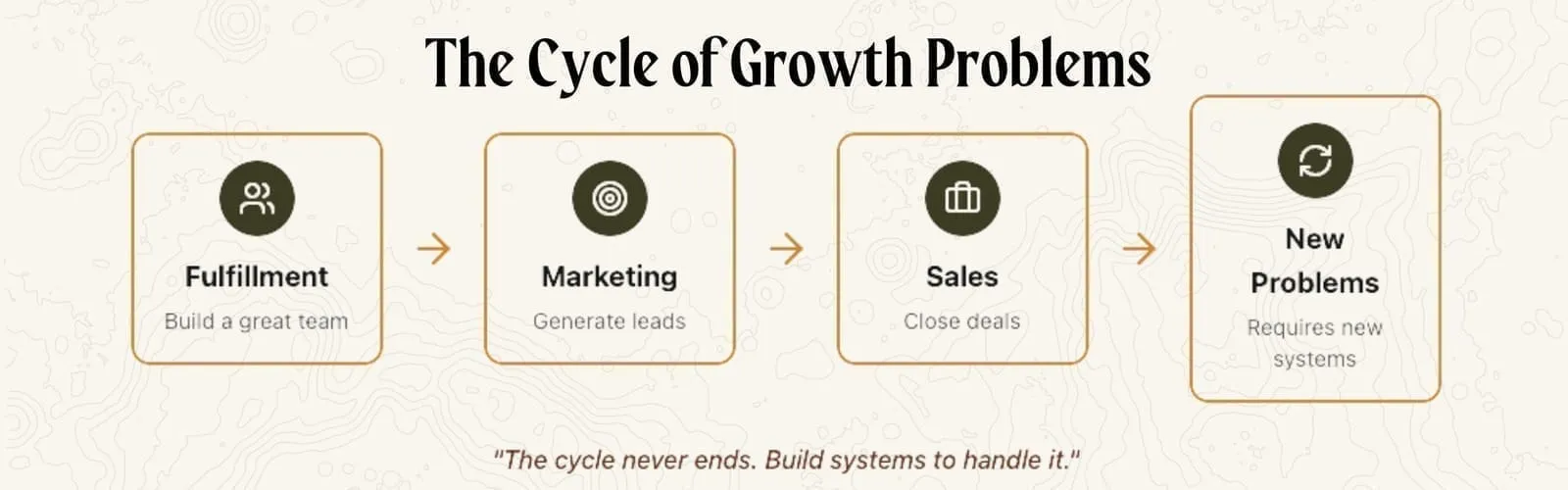
When Freewyld Foundry recently completed a marketing offsite in San Diego, one pattern became crystal clear: we weren’t dealing with unique challenges. We were experiencing the natural evolution of a growing business. First, we built an incredible fulfillment team of revenue managers driving results for clients. That created a marketing problem. Once marketing started pumping out qualified leads, we faced a sales problem. Solving the sales challenge will inevitably create a new fulfillment problem that will require more team members and systems.
This cycle never ends. The sooner you accept that, the sooner you can build systems that handle it.
The Squirrel Problem: Stop Trapping and Start Preventing
Here’s a personal example that illustrates the hectic host mentality perfectly. After moving into a new home, squirrels took up residence in the roof. The immediate reaction? Hire a pest control company for $800 to trap the squirrels. They caught a couple of chipmunks, dealt with them, and the problem seemed solved.
Until three more squirrels appeared in the trees outside the window.
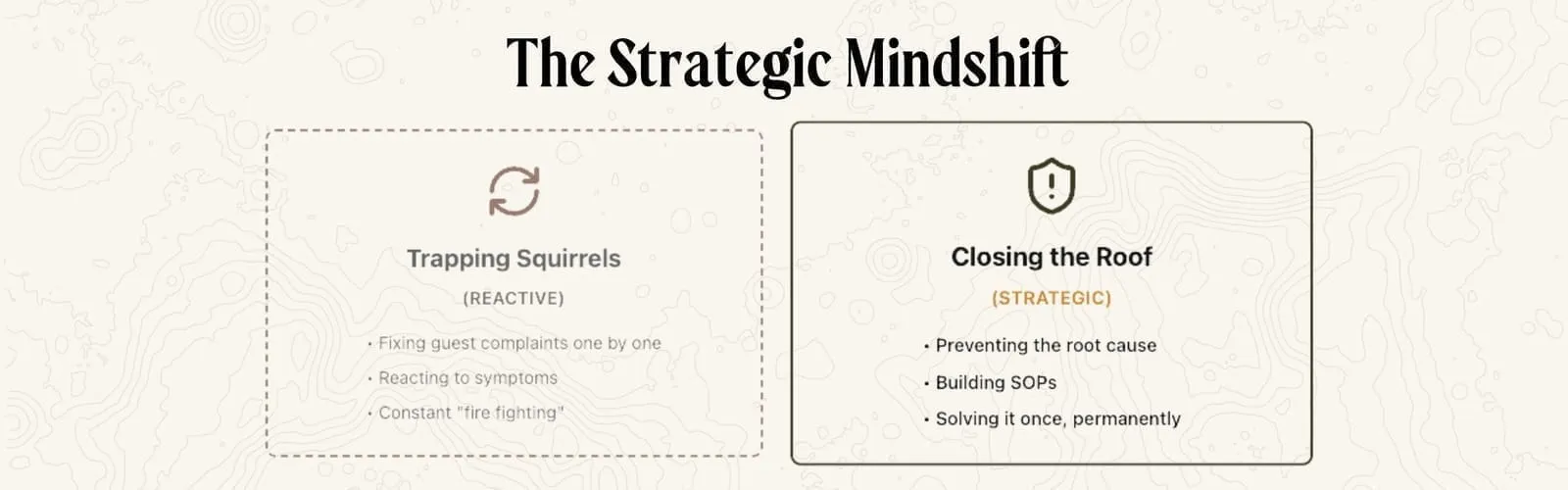
The real solution wasn’t trapping every squirrel in the neighborhood. It was closing the hole in the roof where they were getting in.
In your short-term rental business, you’re probably spending enormous energy trapping squirrels. A guest complaint here, a maintenance issue there, a pricing problem with this listing, a team conflict over there. You’re reacting to symptoms instead of fixing root causes.
The strategic question you need to ask constantly: “Am I trapping squirrels, or am I closing the hole in the roof?”
Let the Little Fires Burn
Another critical mindset shift for escaping hectic host mode is learning to let the little fires burn. Not every problem deserves your immediate attention. Not every opportunity deserves to be pursued right now.
Take this real example from Freewyld Foundry’s recent decision-making process. The team identified a need for a new CRM system. The existing sales system was working but breaking down in places. The temptation was to jump immediately into a complete overhaul.
But pause. Ask the key question: “Is this the one thing that will get us closer to our goal right now?”
Despite its imperfections, the current system has brought the company to its current stage. It was still functioning. Meanwhile, the new operations manager had multiple critical projects on her plate. Adding a heavy technical lift at that moment would split focus across too many initiatives.
The decision? Let that fire burn. The system that got you here might not be perfect, but if it’s working, it can wait while you focus on the bottleneck that’s actually holding you back right now.
This applies directly to property management operations. You might be eyeing a new property management system, considering a website redesign, or planning to expand into a new market. But if your current bottleneck is inconsistent cleaning quality or poor guest communication, those other projects are squirrels. Fix the roof first.
The Productivity Framework That Actually Works
Most property managers are familiar with the important versus urgent matrix, but few apply it consistently. Here’s how to think about prioritization in your business:
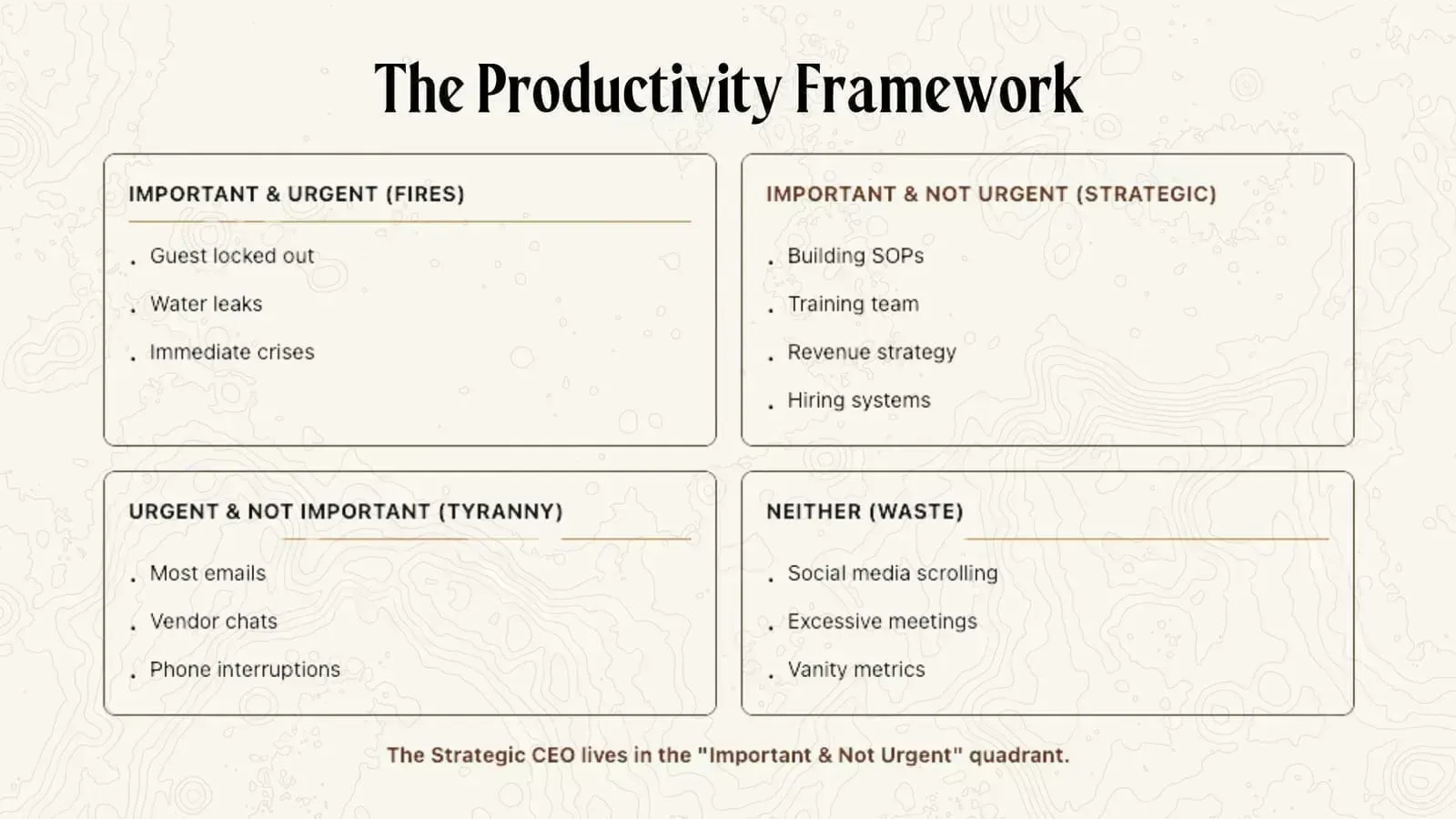
Important and Urgent: These are your true fires. A guest locked out at midnight. A water leak flooding a property. These demand immediate attention.
Important but Not Urgent: This is where strategic growth lives. Building standard operating procedures. Training team members properly. Implementing a revenue management strategy. These items move your business forward but don’t scream at you daily.
Urgent but Not Important: The tyranny of the moment. Most emails. Many phone calls. That cleaning vendor who wants to chat. These feel pressing, but don’t move the needle.
Neither Important nor Urgent: Social media scrolling disguised as “market research.” Excessive meetings. Overanalyzing metrics that don’t impact decisions.
The hectic host lives almost entirely in the urgent quadrants. The strategic CEO deliberately carves out time for important but not urgent activities, knowing these build the systems that eventually eliminate the urgent fires.
Building Your First Line of Defense: Strategic Meetings
If you’re allergic to meetings, you’re not alone. Most entrepreneurs resist adding more calls to their calendar. But here’s the counterintuitive truth: the right meeting structure actually buys back your time.
Freewyld Foundry recently implemented a daily standup for the marketing team, Tuesday through Friday, in addition to their main Monday team meetings. The initial resistance was real. “Do we have to meet every day?”
But the first standup immediately revealed two critical issues: one team member needed additional training on the project management system, and another had questions about workload distribution that were creating bottlenecks.
Without that 15-minute daily check-in, those issues would have festered for days or weeks, causing delays and frustration. Instead, they were identified and addressed immediately.
The key to effective daily standups:
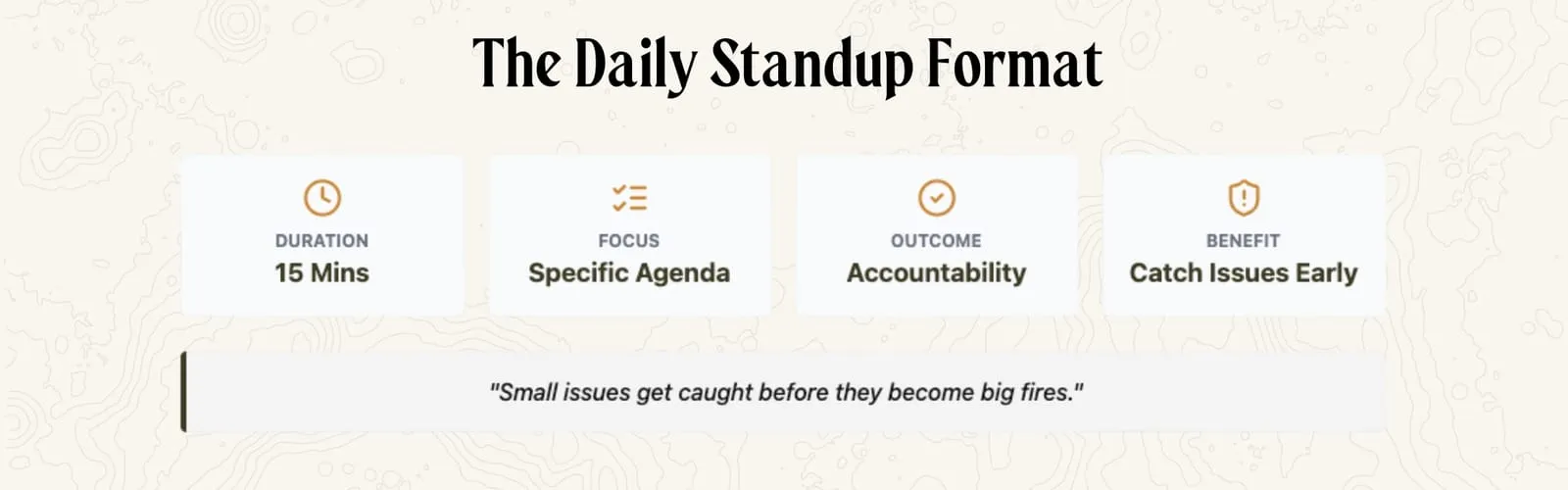
They’re short. Fifteen minutes maximum. Everyone knows this call ends on time, which keeps energy high and focus sharp.
They follow a specific agenda. What did you accomplish yesterday? What are you working on today? Where are you stuck? That’s it.
They create accountability. When you know you’ll report progress daily, you stay focused on the work that matters.
They surface problems early. Small issues get caught before they become big fires.
For property managers, this might look like a daily standup with your cleaning coordinator, maintenance lead, and guest services manager. Five people, fifteen minutes, five days a week. That’s just over an hour weekly to stay aligned and catch problems early.
The alternative? Playing phone tag, missing critical details, and spending hours fixing problems that could have been prevented with a quick conversation.
The Offsite Advantage: Why Quarterly In-Person Meetings Matter
Freewyld Foundry operates as a fully remote team spread across the world. But they prioritize in-person off-sites roughly once per quarter, and the return on investment is undeniable.
The recent San Diego marketing offsite produced multiple breakthrough moments:
Complete rebuild of project management templates and workflows in ClickUp, creating clarity on who owns what and when things are due.
Implementation of the daily standup cadence that’s already paying dividends.
A focused analysis of key performance indicators, eliminating vanity metrics and zeroing in on numbers that actually drive decisions.
Strategic hiring decisions to keep team members in their lanes instead of spreading them across too many responsibilities.
A consultation with a Meta ads expert that provided perspective and direction worth thousands of dollars in avoided trial and error.
These outcomes don’t happen in Slack messages or video calls. There’s something about physical presence, extended focus time, and the ability to whiteboard ideas together that creates momentum impossible to replicate virtually.
If you’re running a property management business with any team at all, even if it’s just you and one virtual assistant, plan at least one offsite this year. Rent an Airbnb for two days. Bring your key people together. Work through your biggest bottlenecks. The investment will pay for itself many times over.
Real-World Example: The Power of Strategic Hiring
Here’s a specific case study that illustrates the importance of keeping people in their lane.
Freewyld Foundry recently ran one job scorecard through ChatGPT to clarify expectations and responsibilities. The result was eye-opening: they had created one position that actually required two, possibly three different roles. They were asking one person to handle strategic planning, tactical execution, and technical implementation simultaneously.
No wonder the position wasn’t producing expected results. The person was being pulled in three directions, unable to excel at any single function.
The solution wasn’t to find a more talented person or provide better training. It was to rebuild the structure, hire specialists for each role, and let people focus on what they do best.
This same pattern shows up constantly in property management. You hire someone as a “property manager,” but you’re actually asking them to handle guest communication, coordinate cleaners and maintenance, manage pricing, market the property, handle bookings, and deal with owner relations.
That’s not one job. That’s at least four jobs. And when one person tries to do all of them, everything suffers.
The strategic approach? Identify the core functions in your business. For each function, ask: “What would world-class look like here?” Then hire specialists who can own that function completely.
In Freewyld Foundry’s case, they’re adding several part-time positions to the marketing department instead of stretching existing team members. Each person will have 100% focus on their specific job, driving better results than asking fewer people to juggle more responsibilities.
The KPI Trap: Measuring What Matters
When you’re in hectic host mode, you often fall into one of two extremes when it comes to metrics. Either you measure nothing, flying blind and making decisions based on gut feel, or you measure everything, drowning in data without clear direction.
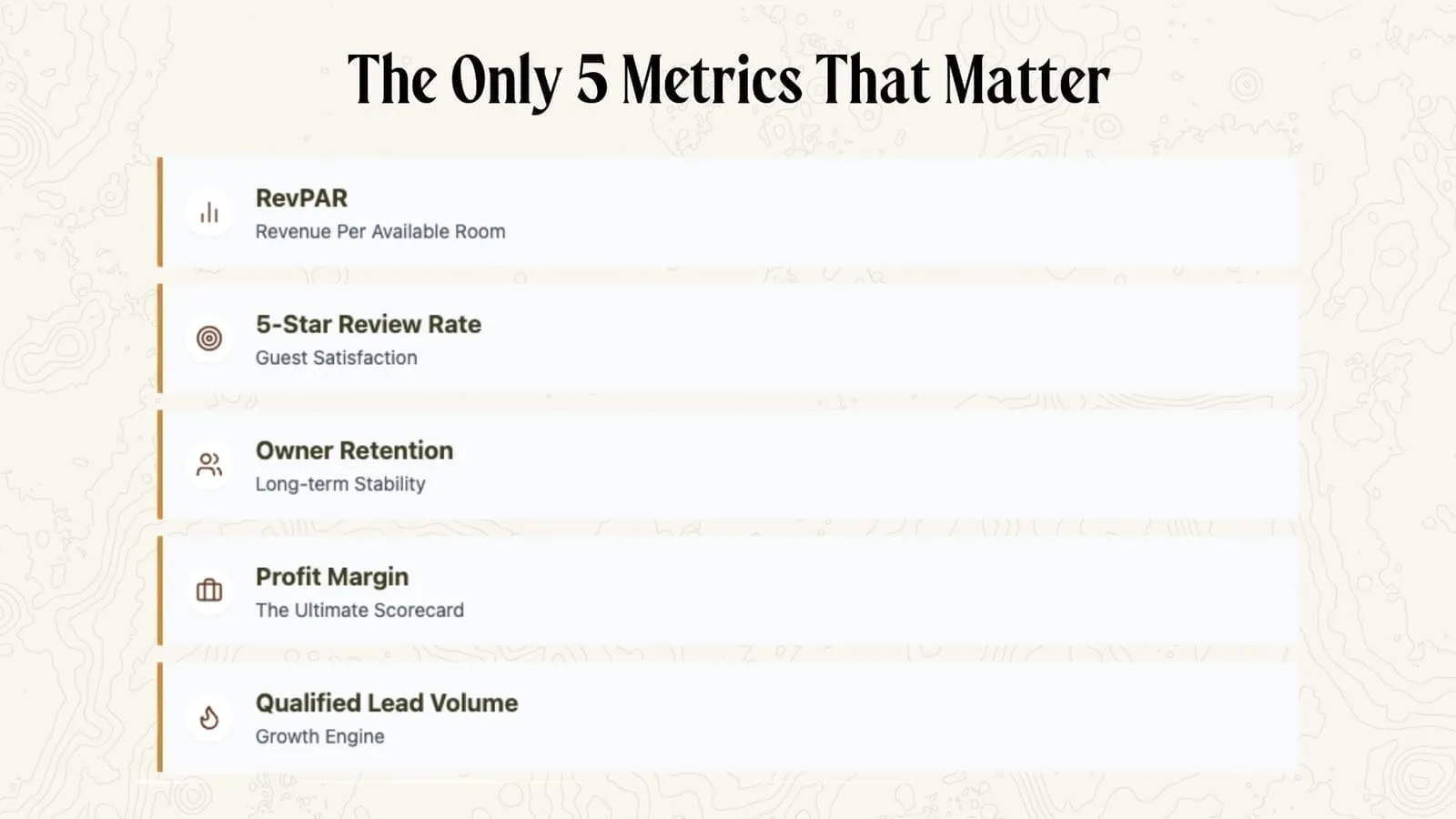
The strategic middle ground? Track everything you can in the background, but focus decision-making on three to five key performance indicators that truly reflect business health.
For most short-term rental operators, the critical metrics are:
RevPAR (Revenue Per Available Room): This tells you if you’re maximizing revenue across your portfolio, accounting for both rate and occupancy.
Five-Star Review Rate: Guest satisfaction directly impacts your ability to maintain rates and attract future bookings.
Owner Retention: If you’re managing properties for others, retention is your most important long-term metric.
Profit Margin: The ultimate scorecard. If you’re not profitable, you’re eventually dead.
Qualified Lead Volume: For your growth engine, how many serious prospects are you generating monthly?
Notice what’s not on that list: follower counts on social media, number of listings, total gross revenue without context, or dozens of other vanity metrics that feel good but don’t drive decisions.
The trap many operators fall into is spending time collecting numbers they never act on. If you’re tracking something weekly but haven’t made a single decision based on that metric in six months, stop tracking it. That time debt adds up.
A helpful exercise: create a two-column chart. In the left column, list every metric you currently track. In the right column, write down the last time that metric caused you to take action or make a decision. If the right column is empty, eliminate that metric from your weekly routine.
Simplify Your Portfolio: The Sniper Approach
One of the biggest traps in the hectic host stage is portfolio sprawl. You say yes to everything because every listing represents revenue. But complexity kills scale.
Freewyld Foundry recently completed a revenue report for a property manager with a portfolio ranging from studio apartments in undesirable areas to five-million-dollar luxury mansions. The portfolio looked impressive on paper, but the operational complexity was destroying the team.
The studios required completely different systems, pricing strategies, and guest management from the luxury homes. The team was constantly context-switching, unable to develop deep expertise in any one segment.
The recommendation? Cut 50% of the listings and go all-in on luxury homes. Specialize in one thing. Build systems optimized for that segment. Develop expertise. Create a brand known for excellence in that niche.
This applies beyond property types. It applies to markets, guest types, booking channels, and every other dimension of your business. The more you simplify, the more you can systematize. The more you systematize, the more you can scale.
Ask yourself: “If I could only manage properties in one price range, one location, and one style, which would I choose?” That’s probably where you should focus your growth energy.
Tapping Your Network: The Consultant Advantage
The hectic host believes they need to figure everything out themselves. The strategic CEO leverages expertise ruthlessly.
When Freewyld Foundry needed to optimize their Meta ads strategy, they didn’t spend three months testing and iterating. They brought in a consultant with proven expertise. One conversation provided clarity and direction that would have taken months to discover through trial and error.
When a client texted about negotiating the biggest deals of his career and needed guidance beyond the team’s experience level, the response wasn’t to fumble through it. It was to immediately connect him with someone in the network who had done exactly that deal structure before.
This is how you speed up progress: recognize what you don’t know, find someone who does know, and pay them to transfer that knowledge.
For property managers, this might mean hiring a revenue management consultant for a portfolio audit, bringing in an operations expert to redesign your systems, or partnering with a marketing specialist to build your direct booking strategy.
The investment in expertise pays for itself through avoided mistakes and accelerated results. You’re at a stage where you can afford to invest in consultants and experts. Stop trying to learn everything through expensive trial-and-error.
The Jobs-to-be-Done Exercise
Here’s a practical exercise you can complete this week to gain clarity on your hiring and systems needs.
Create a two-column spreadsheet. In the left column, list every recurring task in your business. Include everything from answering guest inquiries to pricing updates to accounting to social media posting. Be exhaustive.
In the right column, write the name of the person who currently handles that task.
You’ll quickly see patterns emerge. Your name probably appears 40+ times. Maybe you have one assistant whose name shows up 20 times across wildly different functions.
This exercise makes the problem visible. You can’t fix what you can’t see.
Once you have the complete list, start grouping related tasks together. All the guest communication tasks go together. All the pricing and revenue management tasks are grouped together. All the marketing tasks cluster together.
Now ask: “Could a talented person do all the tasks in this group full-time?” If yes, you’ve identified a potential hire. If the group is too small for a full-time role, it might be a part-time position or a function to outsource to a specialist.
This exercise transforms vague overwhelm into concrete hiring needs. Instead of thinking, “I need help with everything,” you can identify, “I need a dedicated guest services coordinator who handles all communication from inquiry through checkout.”
Summary and Key Takeaways
Escaping hectic host mode requires systems, not just hustle. Your problems aren’t unique. Every growing business faces an endless cycle of problem-solving. The difference is how systematically you approach solutions.
Let the little fires burn. Not every problem or opportunity deserves immediate attention. Focus on the one bottleneck preventing your next level of growth. Everything else can wait.
Simplify relentlessly. In your portfolio, your metrics, your team structure, and your focus. Complexity kills scale. Specialization enables expertise.
Build meeting cadence and culture. Daily standups keep teams aligned. Quarterly off-sites create breakthrough moments. These aren’t time wasters. They’re your fastest path to clarity.
Hire snipers, not generalists. Keep people in their lane. One role, done excellently, beats three roles done adequately.
Measure what matters, ignore the rest. Three to five key metrics should drive your decisions. Everything else is background noise.
Leverage expertise ruthlessly. Consultants and specialists accelerate your progress. Stop trying to figure everything out alone.
Next Steps: Take Action Now
You’ve made it through 2,400+ words of strategy and systems thinking. Now comes the hard part: implementation.
Start with one action this week. Just one. Maybe it’s scheduling your first daily standup. Maybe it’s completing the jobs-to-be-done exercise. Maybe it’s identifying which “little fire” you’re going to let burn so you can focus on closing the hole in your roof.
Whatever you choose, the key is momentum. Small, consistent actions compound into massive results over time.
Here’s my question for you: What’s the one bottleneck in your business right now that, if solved, would unlock your next level of growth? And what’s keeping you from addressing it?
Ready to dive deeper into building a business that works for you instead of the other way around? Join our newsletter where we share behind-the-scenes strategies from Freewyld Foundry every week. No fluff, just practical systems you can implement immediately.
Internal Links:
- Ep679 – 2026 Pricing Strategies Every Short-Term Rental Operator Must Use
https://freewyldfoundry.com/ep679-str-pricing-strategies-2026/ - Ep673 – FIFA World Cup 2026: How STR Hosts Can Win (Action Plan)
https://freewyldfoundry.com/ep673-fifa-world-cup-2026/ - Ep652 – How to Maximize 5-Star Guest Reviews on Airbnb
https://freewyldfoundry.com/ep652-how-to-maximize-5-star-guest-reviews-on-airbnb/